
Applying perovskite solar cells onto BIPV steel products
Swansea University will collaborate with Indian multinational Tata Steel to investigate perovskite solar cell materials that could be applied directly onto coated steel to make building-integrated PV components. The partnership will add to an “active buildings” project that the Welsh university has been running for several years.
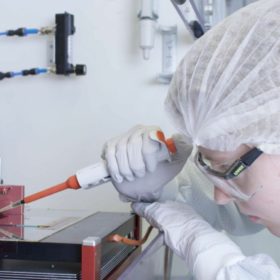
Eco-friendly solvent for a 16.7% perovskite solar cell
Scientists in Germany looked to eliminate the use of toxic solvents in the production of perovskite solar cells, replacing them with a more environmentally material called dimethyl sulfoxide (DMSO) which has so far proved difficult to integrate into processes suitable for large-scale production. The group demonstrated a scalable blade coating process using DMSO as the only solvent, and reached cell efficiencies close to those achieved using more toxic substances.
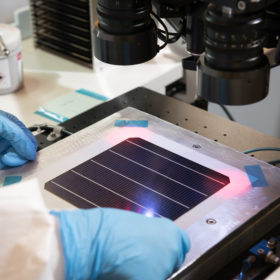
Environmental impacts of perovskite PV
A life-cycle analysis of perovskite-silicon tandem modules indicates that additional environmental impacts in manufacturing are more than offset by the higher energy yield over their lifetime.

Large-area graphene-perovskite solar modules with better temperature coefficient
An Italian-Greek research group has developed a large-area perovskite solar panel with graphene-doped electron transporting layers. With increasing temperatures, the module exhibits a smaller drop in open-circuit voltage than commercially available crystalline silicon panels.
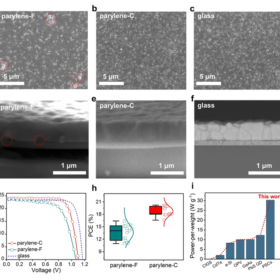
Ultra-thin inverted perovskite solar cell with 20.2% efficiency
Chinese scientists have developed an ultralight solar cell with perovskite film based on a 3-µm-thick polymer. It purportedly has a power conversion efficiency in line with that of perovskite cells of conventional thickness.

Tuning out the defects for more powerful perovskite solar cells
Scientists in the UK and Japan used the latest imaging techniques to observe the inner workings of a perovskite solar cell at the scale of a few nanometers. Their findings suggest that a single defect is responsible for both limiting initial performance and causing degradation of the cell. By altering chemical compositions and process parameters, the appearance of this defect can be quickly reduced, and the group is confident that its finding could quickly be applied in large-scale processing as well.
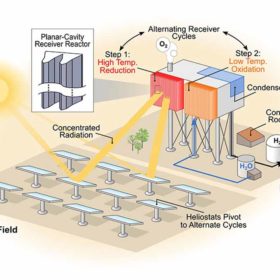
Perovskites studied as potential material to produce renewable hydrogen
National Renewable Energy Laboratory researchers are looking at perovskite materials for a solar-fuel platform that supports the US Department of Energy’s HydroGEN project.
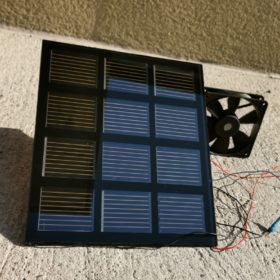
Titanium oxide nanoparticle-based perovskite PV cell with 24.05% efficiency
A new perovskite PV cell based on titanium dioxide nanoparticles exhibits low efficiency losses when scaled up from cell to module.
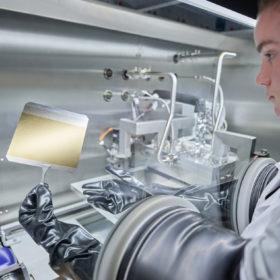
Atomic layer deposition tool for perovskite cell pilot line
Dutch equipment supplier SALD has announced delivery of a spatial atomic layer deposition system to an unnamed customer in the United States. The tool will be used in the pilot-scale production of perovskite solar cells. While it has not disclosed the exact function of the tool within the pilot project, it said it will be used to deposit thin coatings to protect cells from damage in later manufacturing stages, and ensure their longer-term stability.
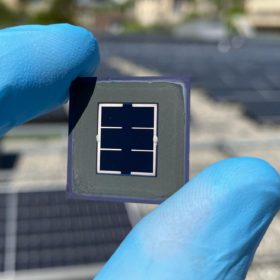
EPFL achieves 29.2% efficiency for tandem solar cell with fully textured silicon
Scientists in Switzerland made significant progress with an approach to perovskite-silicon tandem cell design that they say could eventually be integrated into existing silicon PV manufacturing. They have announced the achievement of a 29.2% cell efficiency – not far from the overall record for tandem cells, and verified by Germany’s Fraunhofer ISE.
