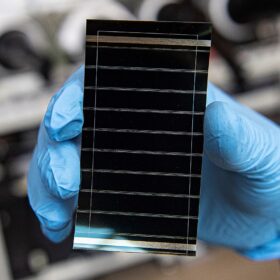
Caelux developing perovskite-silicon tandem solar with four-terminal configuration
While many perovskite developers pursue a 2-terminal format, which poses design and production constraints, Caelux uses a 4-terminal approach that can reportedly help bypass technical challenges.
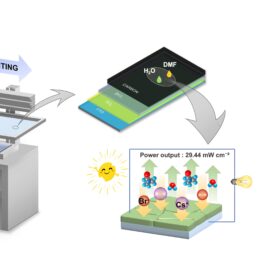
Chinese scientists improve carbon perovskite solar cell performance via dual-solvent process
A team of researchers in China has demonstrated a novel dual-solvent process in 4-terminal carbon CsPbBr3 perovskite solar cells that achieve 10.18% power conversion efficiency. They have also built a large area 17.88 cm2 device achieving an 8.72% efficiency while retaining 93.2% of the initial performance after 1,000 hours of operation at 150 C.

Scientists propose manufacturing process to build perovskite solar cells on the Moon
German scientists believe that power generation for future habitats on the moon could be achieved by manufacturing halide perovskite cells locally, using regolith-based moonglass.
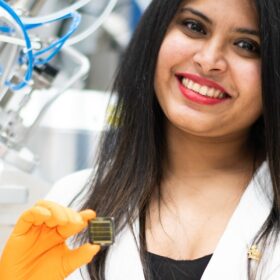
Alumina oxide nanoparticles extend perovskite solar cell lifetime
Scientists in the U.K. have used alumina oxide in perovskite solar cells to achieve lifetimes exceeding 1,300 h under standards-based heat and humidity testing. Their analysis showed that a reference cell based on conjugated polyelectrolytes degraded in one-tenth the time.
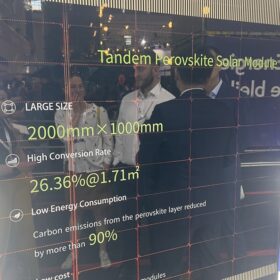
Chinese PV Industry Brief: Kelin Electric to raise funds for 1 GW perovskite project
Kelin Electric says it plans to raise up to CNY 1.46 billion ($201.8 million) through a private placement, with CNY 1.26 billion allocated for a 1 GW perovskite solar module project in Hangzhou, Zhejiang province.
Dutch consortium seeks to reduce costs of hole transport layers for perovskite solar cells
Two Dutch manufacturers have teamed with TNO’s perovskite solar cell experts to integrate spatial atomic layer deposition equipment to produce ultra-thin, high-quality nickel-oxide hole transport layers in a roll-to-roll process. The team targeting production integration in mid-2027, with full-scale production by 2030.
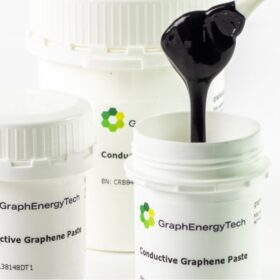
Replacing silver in PV manufacturing with new graphene electrode technology
Swiss-British university spinoff, GraphEnergyTech, is developing graphene electrode technology to replace silver and other metals traditionally used in solar cell manufacturing.
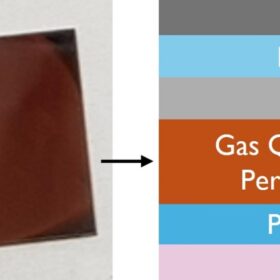
Gas quenching with helium, argon for more stable perovskite solar cells
Kuwait University researchers investigated the relationship between the molecular weight of the quenching gas and the morphology of perovskite films used in solar cells, finding that argon and helium extended device lifetimes compared to using the more conventional nitrogen.
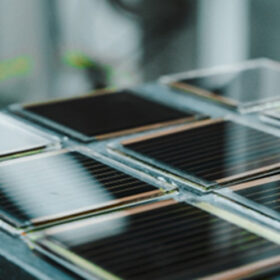
Chinese scientists build 20.3%-efficient mini inverted perovskite solar modules via slot die coating
A team led by University of Electronic Science and Technology of China (UESTC) has found that pyrrodiazole as an additive in formamidinium iodide (FAI)-based inverted perovskite solar enables larger area devices made with industry-compatible slot die coating. Modules made using the technology achieved 20.3% certified power conversion efficiency and retained 94% of initial efficiency after 1,000 h in standard testing.

Power Roll developing 12.8%-efficient back-contact perovskite solar devices
Researchers from the U.K.’s University of Sheffield and Power Roll, a perovskite solar PV technology company, have achieved 12.8% power conversion efficiency in indium-free devices based on novel back-contact process. A slot-die coating process was demonstrated, compatible with roll-to-roll manufacturing.
