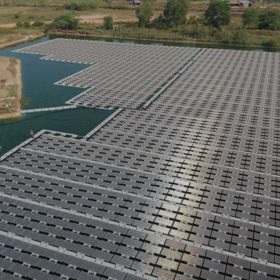
Floating solar reaches new territories
In Cambodia, Singapore’s Cleantech is building a 10 MW solar plant including a 2.7 MW floating section, and in Lithuania, state-owned utility Lietuvos Energija is deploying a floating plant at the Kruonis pumped storage hydroelectric power plant.
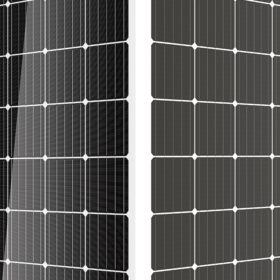
Trina to ship 16 MW of its bifacial panels for French projects
The Chinese manufacturer will supply EDF with around 45,000 bifacial, double glass Duomax Twin panels. The French utility will use the modules for two large-scale projects selected through tenders held by energy regulator CRE.
Europe’s 100% renewables dream needs a flexible grid concept and more storage
A European energy system powered solely by renewables is economically feasible, according to a study which suggests decentralized energy systems operating within the framework of a stronger pan-European energy trade could reduce the cost of electricity from the €69/MWh price seen four years ago to around €51 in 2050.

Portugal approves plan to improve grid, announces 1.75 GW to be allocated in first solar auction
Portugal’s government has approved its 2018-2027 plan to strengthen its grid to integrate large volumes of renewable energy. Environment minister João Matos Fernandes has also revealed the solar auction planned for next summer will offer around 1.75 GW of capacity.
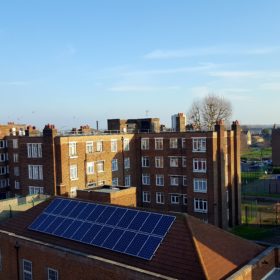
Kyocera uses blockchain to test virtual power plant based on solar and storage
The module maker and electronics giant is testing the feasibility of a complex virtual power plant with a blockchain platform provided by US-based LO3 Energy.

ACWA wins Bahrain’s 100 MW PV tender with bid of $0.039/kWh
The tender process for a solar park at the Askar landfill site was launched by Bahrain’s Electricity and Water Authority in March 2017.

First unsubsidized solar parks announced in Canada
After receiving its cheapest bids for large-scale solar under a public tender a week ago, the Canadian province of Alberta is now ready to host two unsubsidized solar parks with a combined capacity of 57 MW. The developer, German renewable energy company Innogy, is in talks with local off-takers about signing a PPA.
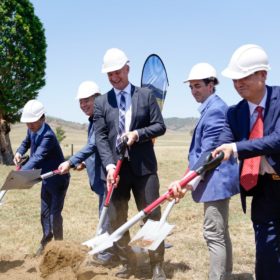
1.5 GW solar, 500 MWh battery project breaks ground in Australia
The first sod has been turned on a massive solar+storage development located between Harlin and Kilcoy, in south-east Queensland. The project was proposed by Sunshine Energy Australia, a newcomer to the Aussie solar scene.
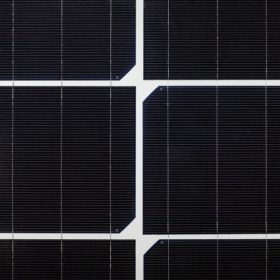
Markets started to embrace non-conventional modules in 2H 2018
Analysts at PV InfoLink said the number of markets open to new technologies such as half-cut and shingled panels is constantly rising. Australia, Japan, Spain, the UAE and Brazil were cited as the hottest markets for Chinese “special modules”. Total annual production in China for half-cut modules, which are set to increase their market share this year, should reach around 20 GW.

Spain raises 2030 renewables target
Catalan independence protests notwithstanding, the Spanish government’s Council of Ministers is today set to approve “three essential pillars” of its climate change policy: the preliminary draft of the Climate Change Law, the Integrated National Energy and Climate Plan 2021-2030 and the Fair Transition Strategy, to “allow Spain to have a stable, predictable and accurate framework for the decarbonization of its economy by 2050”. The measures, said president Pedro Sánchez, could generate 300,000 jobs.
