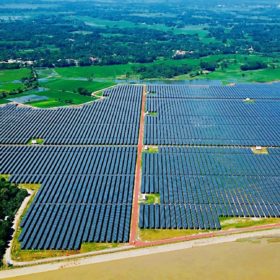
Bangladesh’s largest PV plant comes online
The solar facility will sell power to the Power Grid Company of Bangladesh under a 20-year PPA.
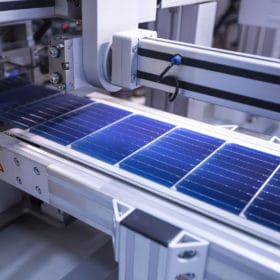
ITRPV: Large formats are here to stay
The 2021 edition of the International Technology Roadmap for Photovoltaics (ITRPV) was published today by German engineering association VDMA. The report, which forecasts technology trends across the solar industry, expects PERC to maintain its position as the dominant cell technology and notes that large wafer formats are here to stay.
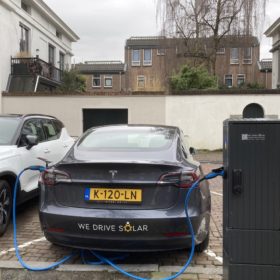
Electric cars to store renewables in the Netherlands
We Drive Solar and Hyundai are planning to set up a network of 500 bi-directional EV recharging stations in the city and region of Utrecht. Through this technology, electric cars may contribute to the storage of renewable energy in a country affected by grid constraints.
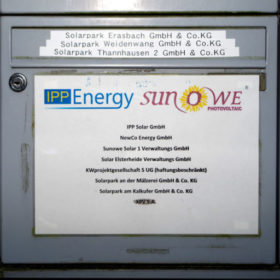
Sunowe’s panel-smuggling trial to resume in Germany
Sunowe’s trial over allegations of PV module smuggling is expected to resume on May 4. The company has been accused of not paying €20 million in anti-dumping and anti-subsidy tariffs.
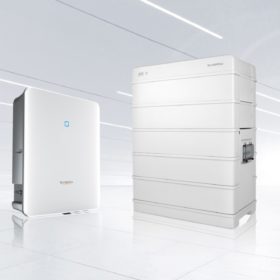
Sungrow launches high-voltage battery and hybrid inverter for residential applications
The Chinese manufacturer will begin selling its new products in Australia and Europe. The hybrid inverter has an efficiency of up to 98.4% and the lithium iron phosphate battery features a storage capacity between 9.6 kWh and 102.4 kWh, depending on the number of modules.

New York state launches fifth large-scale renewables solicitation
Twenty large-scale renewable energy infrastructure projects are under construction in New York state, paving the way for it to meet its goal of sourcing 70% of its electricity from renewable sources by 2030.

Italy devotes €1.1bn to agrivoltaics, €2bn to energy communities and storage
The funds will be part of the EU Covid-19 recovery package. Overall, the Italian government expects to deploy 2 GW of agrivoltaics and 2 GW through energy communities.

Turkey’s 1 GW PV tender sees lowest bid drop to $0.022/kWh
The first phase of the procurement exercise is expected to be finalized by the end of the week. The record low bid, for Turkey, was submitted for a 10 MW project in the Antalya region, in the sunny southern part of the country.
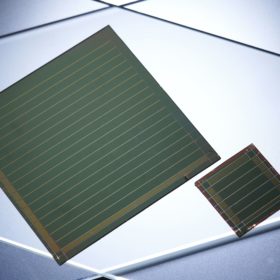
Large-area perovskite solar module with 18% efficiency
Researchers in Germany claim to have overcome the main challenge for the development of large-area perovskite PV modules – scaling up from the cell to the module level. They achieved an efficiency of up to 16.6% on a module surface of more than 50 centimeters squared, and 18% on a module with an area of 4 centimeters squared.
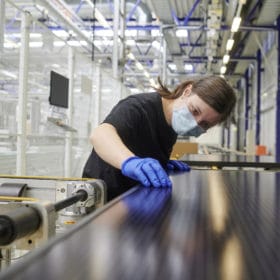
Meyer Burger unveils 400 W heterojunction solar module
The solar module will be available in three versions – white, black, and glass-glass. The products have an output of up to 400 W, but when the bifacial effect is optimally used, the output of the glass-glass module can reach up to 430 W. Both the white and black modules weigh less than 20 kg
