
Gambia maintains solar ambition
The country’s power utility has completed the pre-selection process to seek developers for a 20 MW solar project in the Banjul region. The project will feature up to four PV plants and will be developed under the national Electricity Restoration and Modernization Project.
Covid-19 halting European PPA market
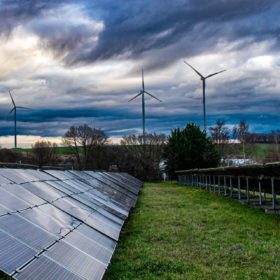
Analysts from German energy advisory Enervis have told pv magazine power purchase agreement-linked solar projects which are under development in Europe may be delayed by the Covid-19 outbreak and new unsubsidized projects appear unlikely any time soon, thanks to the current economics.

Designing super-strong solar modules for the tropics
An international research team has defined the operational parameters needed to design and manufacture crystalline silicon PV modules for tropical climates. The group proposed a back-junction, back-contact cell tech with a selective laser soldering technique it claims offers the best potential to yield such robust panels.
Germany and France modify solar tenders because of Covid-19
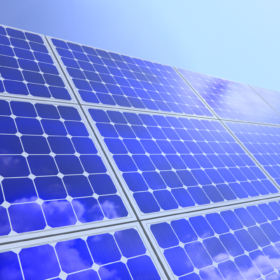
The governments of both countries are answering solar industry requests by adjusting tender schemes and considering measures to avoid financial penalties and the loss of incentives due to missed deadlines.
A dual-angle approach to building solar plants at higher latitudes
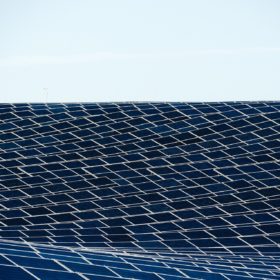
A research team in the US has proposed a ‘dual-angle solar harvesting’ method it is claimed could help PV developers optimize energy yield and land use. It is claimed the method would be particularly suitable for projects in cloudier climates and at higher latitudes.

New York allocates 1 GW of solar as renewables auction delivers $18.59/MWh average price
The results of New York Statevs most recent renewable energy request for proposals are in. Some 21 large scale clean energy projects with 1,278 MW of new capacity have been awarded, with 17 of the projects supplying 1,090 MW of solar.

Estonian renewables auction attracts 17 bidders
The winners in the Baltic nation’s first clean energy auction will be announced by June 20. With the exercise rated according to the expected output of the facilities allocated, the government has committed to procure 5 GW worth of facilities, from a total 16.3 GW offered by bidders.
How Covid-19 is affecting the French solar sector
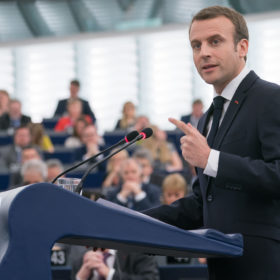
Franc Raffalli, president of the Photovoltaic Professions Group of the French Building Federation spoke to pv magazine about the impact of the coronavirus on the French PV industry.
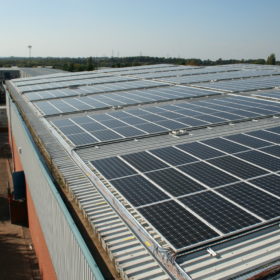
Energy communities are now allowed in France
A footnote in France’s energy legislation had been holding back the development of collective self-consumption in the country, limiting such projects to ‘experimental’ status with terms of no more than five years. The removal of this footnote at the beginning of March means that energy communities for self-consumption are now permitted across the country.
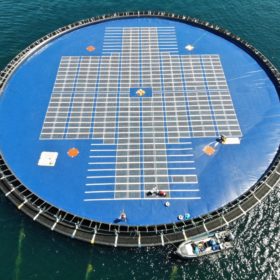
Floating PV learning from aquaculture industry
The CEO of Norwegian floating solar company Ocean Sun has spoken to pv magazine about his company’s innovative design for floating PV projects in near-shore locations and semi-sheltered waters. A pilot project built in the Philippines last year, said Børge Bjørneklett, is providing better-than-expected power output.
