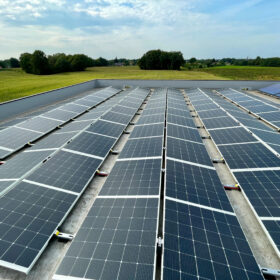
Lightweight PV system solution for commercial buildings with limited load-bearing capacity
Dutch solar PV manufacturer Solarge is deploying a novel lightweight rooftop solution across several commercial buildings in the Netherlands. Instead of glass, the special modules developed by the company use strong and light polymers, which the company said result in a module weight per square meter of 5.5 kg.
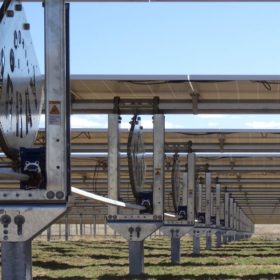
Novel mathematical model to assess wind stability of solar trackers
Researchers from Spain have developed a method to estimate the critical speed a tracker can withstand. They found “good agreement” when comparing the model to experimental results.

Turkey could generate 120 GW through better solar rooftop rollout
Introducing rooftop solar “obligations” for new structures and public buildings, as well as tendering suitable apartment building roofs by municipalities, could help Turkey drive up its rooftop solar capacity to 120 GW, according to a new report by think tank Ember.
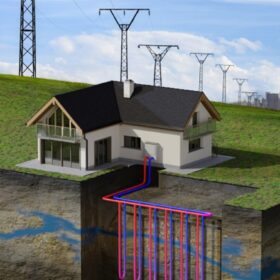
Geothermal heat pumps to decarbonize buildings
The mass adoption of geothermal heat pumps could decarbonize buildings and reduce grid transmission needs, according to a report by Oak Ridge National Laboratory and the US National Renewable Energy Laboratory (NREL).

Uganda kicks off solar tender for 40 PV-powered water supply schemes
Uganda’s Ministry of Water and Environment is inviting eligible bidders to apply to develop 40 solar-powered “packages” for water schemes in a range of locations in the East African country.
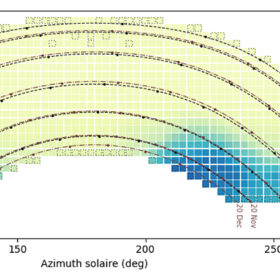
French startup offers AI algorithm package for rooftop PV monitoring
France-based Heliocity has developed HelioFlash, a series of artificial intelligence algorithms that assess PV systems on buildings, while offering recommendations to improve operations.
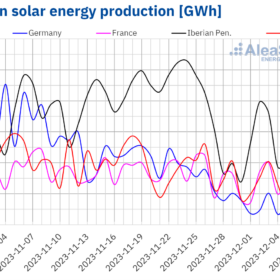
December drop in gas, CO2, Euro electricity market prices
In the first week of December, prices in almost all electricity markets decreased compared to the previous week due to lower gas and CO2 prices, lower electricity demand and higher wind energy production, according to AleaSoft Energy Forecasting.
Empowering the Energy Transition: New IEA-PVPS Task 19 Sets the Stage for Global PV Grid Integration Collaboration
The new IEA-PVPS Task 19, succeeding Task 14, aims at fostering sustainable PV grid integration and invites experts from diverse countries, disciplines, and organizations to join its ambitious projects, with the aim of reshaping the future of electric power networks and positioning PV as a dominant force within evolving power systems.
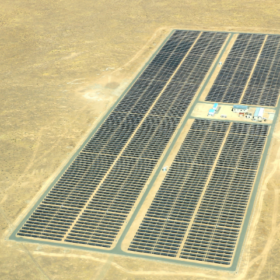
Namibia launches tender for bundle of renewable energy projects
The Namibian government is looking for consultants to provide development, environmental and advisory services for a range of renewable energy projects, including solar, wind and battery energy storage systems (BESS).
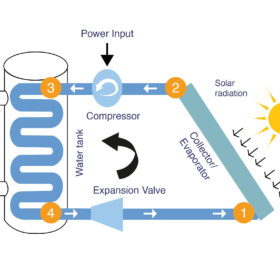
New solar-air dual-source heat pump design based on blower fans
Scientists have utilized two blower fans with two roll-bonded bare plates to create a heat pump that can operate in variety of ambient temperature and solar radiation conditions. The system has an average daily coefficient of performance of 3.24.
