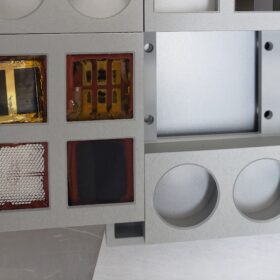
NASA makes unusual discovery while testing perovskite solar cells in space
NASA has discovered that perovskite solar cells tested in space exhibit less degradation than reference devices tested on Earth. The agency acknowledged that it is uncertain about the specific factors in the space environment that contributed to the superior performance of the perovskite absorber film.
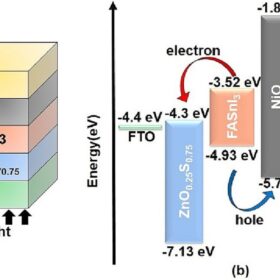
Indian researchers design lead-free perovskite PV cell with 31.57% efficiency
Researchers at India’s National Institute of Technology (NIT) Silchar, Assam, have designed a formamidinium tin iodide (FASnI3) active layer-based perovskite solar cell. It could potentially achieve a power conversion efficiency of 31.57%, while also scoring well on other performance parameters.
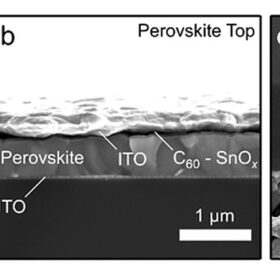
New design for 2T perovskite-silicon tandem solar cells with 24.6% efficiency
TU Delft scientists have built a tandem perovskite-silicon solar cell with a new approach to interface engineering. The device has an open-circuit voltage of 1.81 V, a short-circuit current of 18.1 mA/cm2, and a fill factor of 75.0%.

Storm Minerva hits solar power generation in Italy
In a new weekly update for pv magazine, Solcast, a DNV company, presents the solar irradiance data it collected for Italy in May. These data show that, during the Storm Minerva, solar PV production in Italy and the TransnetBW ISO region in southern Germany was significantly depressed from previous days. Conversely, wind power trended high, due to the intense and widespread nature of the system.
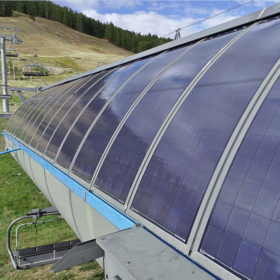
Solar panels for ski areas
French off-grid specialist Sunwind has developed a light, curved solar panel that can be used at ski resorts. It is currently working with CEA-Liten to develop its own solar panel encapsulation line.

New model to assess levelized cost of hydrogen in PV-powered electrolysis
Scientists in Singapore have developed a methodology to calculate the levelized cost of hydrogen in green hydrogen facilities powered by photovoltaics, emphasizing the need for a levelized cost of storage (LCOH) below $10/kg to enable green hydrogen to compete with gray, blue, and orange hydrogen in the current technology landscape.
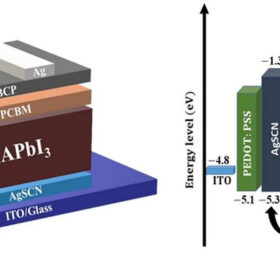
Inverted perovskite PV cell with silver thiocyanate HTL hits 16.66% efficiency
Egyptian researchers have developed a novel hole transport layer (HTL) for inverted perovskite solar cells using silver thiocyanate instead of the commonly used PEDOT:PSS and copper thiocyanate. The new HTL material demonstrated exceptional efficiency and stability in the constructed cell.
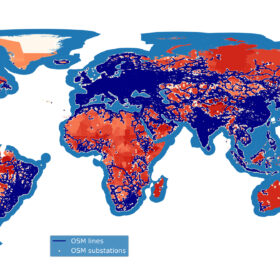
Open-source optimization tool for energy systems offers global coverage
An international research group developed the PyPSA-Earth model for energy system and power studies, technology evaluation, phase-out plans, diversification, and market simulations. It offers accessibility to countries without defined energy planning scenarios.

Japanese group using second-life solar panels at construction sites
Taisei Corp. has installed second-life solar panels at Fukoka Airport’s new office buildings in Japan to test their performance for temporary power production.
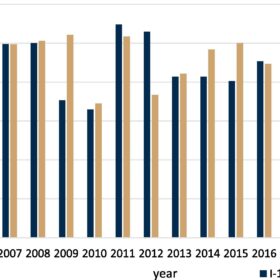
Researchers assess degradation in PV systems older than 15 years
Scientists have used the US National Renewable Energy Laboratory’s (NREL) HOMER software to calculate the degradation of solar panels deployed in two rooftop PV systems operating in Germany since 2003. Their calculations focused on the energy productivity of the systems.
