
Smart meters disrupt residential PV segment in Belgium’s Flanders region
A recent ruling of the Belgian constitutional court has canceled the 15-year grace period granted to residential PV system owners to keep operating under net metering despite the arrival of smart meters. The Flemish government said it will provide some compensation for the financial losses that this decision will cause.

Fraunhofer ISE develops technique to produce glowing colored solar modules
The German research institute has proposed a technique based on the surface structure of the wings of the morpho butterfly to produce colored BIPV panels for facades and rooftops. The process is claimed to make it possible to color the modules with an optical effect and not with color pigments, which reduce their efficiency.
‘There is no clear best module configuration under partial shading’
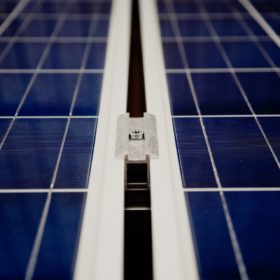
A Slovenian research team has analyzed the behavior of a full-size cell PV module and several 1/6 cell panels under partial shading and has come to the obvious conclusion that the cell cut panels suffer fewer energy losses. They also found, however, that the orientation of the cells connected in series should be aligned as much as possible with the shade shape to lower the losses and to minimize reverse cell voltage.
Belgium deployed 900 MW of PV in 2020
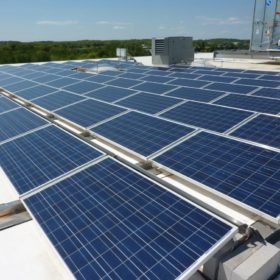
Renewable energy production increased by 31% and now represents 18.6% of the country’s electricity mix. Its cumulative PV capacity increased from 3,887 MW at the end of 2019 to 4,788 MW at the end of December.

Australian Vanadium pushes ahead with plans for residential flow battery
Australian Vanadium is pushing ahead with plans to develop a vanadium redox flow battery for the Australian residential market, via its VSUN Energy subsidiary.
Eon enters UK rooftop PV business
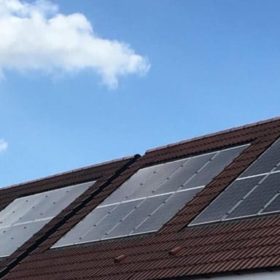
The German energy company has acquired a 49% stake in U.K. installer Eco2solar. The British company offers solutions for commercial and residential projects.
Brazil may add 9 GW of distributed solar over next two years
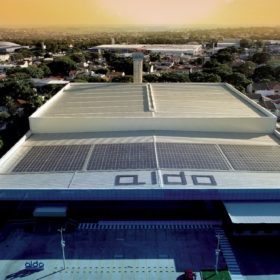
Brazil may see the deployment of 4 GW of new distributed generation solar capacity this year and another 5 GW next year, according to Aldo Pereira Teixeira, the CEO of Brazil’s largest PV product distributor and system integrator. In an interview with pv magazine, he explains why and how this huge growth could materialize.

Tracking rooftop solar trends in India
Simarpreet Singh, director at EPC firm Hartek Group, speaks to pv magazine about the impact of the Covid pandemic on India’s rooftop solar sector, technology trends shaping the market, and the outlook for 2021.

Bangladeshi apparel makers opt for rooftop solar
More than 500 factories have registered to make their manufacturing facilities more eco friendly in the garment exporting powerhouse and the nation’s net metering rules offer an obvious step in the right direction.

Consultant plays down Chinese solar fever
The nation is set to have added 40 GW of solar in 2020 and that figure will rise again this year, to 45-50 GW, according to one of the year’s first industry predictions.
