
Longi reveals back-contact PV test results from offshore environments
The Chinese manufacturer claims back-contact Hi-MO 9 modules outperformed TOPCon counterparts in a six-month offshore test, showing higher power yield, better low-light performance, and lower operating temperatures.
Japanese utility invests in perovskite solar PV startup
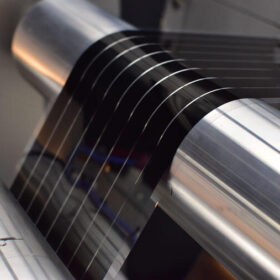
J-Power announced an investment in US-based perovskite solar specialist Active Surfaces, along with plans to pilot product tests.
Enphase announces complete off-grid solar-storage system
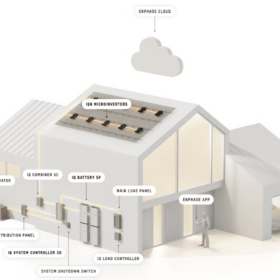
Enphase Energy has introduced a complete off-grid solar and storage system that integrates batteries, microinverters, and generator control, with international rollout set for 2026.
Hybrid PPA model improves PV-BESS bankability, say researchers
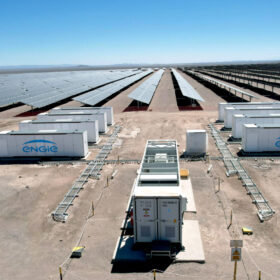
Researchers have modeled a hybrid financing scheme combining contracted and merchant components to improve the bankability of PV-battery energy storage system (PV-BESS) assets, using a Bayesian LSTM forecast integrated with a MILP optimization model to assess performance.
PV power generation forecast technique for solar plants with missing data
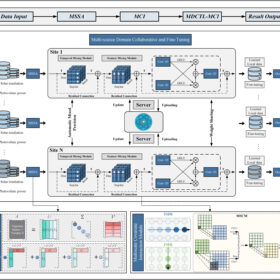
Scientists in China have developed a novel missingness-aware power forecasting method that leverages signal decomposition, multi-scale covariate interaction, and multi-domain collaborative transfer learning. The approach reportedly improves average forecasting accuracy by 15.3%.

SoftBank fine-tunes PV-battery tech for high altitudes
Japan’s SoftBank Corp. has launched a four-year program backed by the New Energy and Industrial Technology Development Organization (NEDO) to advance high-density batteries and high-efficiency solar cells for high-altitude platform station aircraft.

PV-driven desalination system for brackish water
Algerian researchers have built a single-stage solar and battery desalination system for brackish water that uses a hybrid spotted hyena optimizer and maximum power point tracking (MPPT) algorithm to improve efficiency. Simulations and real-time tests showed high performance, steady water output, and low salinity under changing solar conditions.
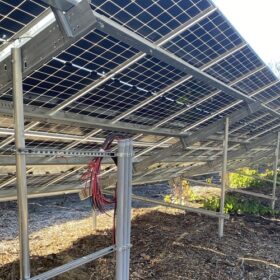
Machine learning-based fault detection technique for bifacial PV
A UAE research team developed a hybrid 1D-CNN and random forest model to detect multiple faults in bifacial PV systems, including dust, shading, aging, and cracks. Using simulated I-V curves and a 180-day synthetic dataset, the model achieved up to 100% accuracy in general state detection and 97.6% in specific fault classification.

Mercedes unveils car with 20% efficient ultra-thin solar coating
Mercedes-Benz unveiled its first car prototype with a silicon-free, 20%-efficient nanoparticle solar coating that powers the vehicle even when off and uses modules thinner than a human hair.
Optimizing solar-plus-storage operation for markets with imbalance penalties
Scientists in Japan have used a deep reinforcement learning–based AI model to calculate discrepancies between the planned and actual electricity supply volumes in PV-battery systems operating in markets where grid imbalances are penalized. Through a series of simulations, they found that the proposed methodology can reduce imbalance penalties by approximately 47%.
