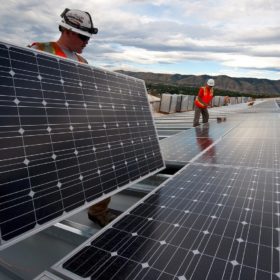
Repositioning Australian rooftop PV
A University of South Australia study has shown that solar owners selling electricity to the grid should position their panels to minimize the discrepancy between peak use and peak production.
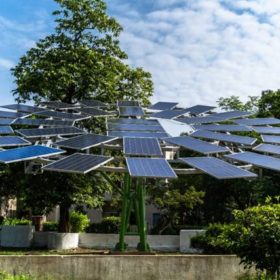
A solar tree for agricultural applications
The Internet of Things (IOT)-enabled solar tree — using 35 solar PV panels with a 330 Wp capacity each — is especially useful for the agricultural community in providing electricity for high-capacity water pumps, e-tractors and e-power tillers. It can also allow precision agriculture through IoT-enabled features such as real-time humidity, wind speed, rainfall prediction and soil health monitoring.
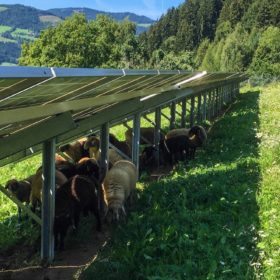
Solar projects enable biodiversity
Eco-Tec, an Austrian PV company, is cooperating with a startup, Meine Blumenwiese, to ecologically upgrade ground-mounted solar projects. The two companies aim to generate clean energy while also creating new habitats for a range of insects and animals.
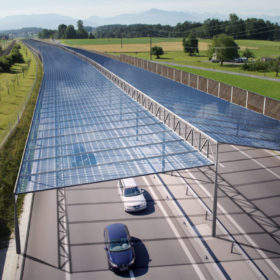
Photovoltaics for highways
The Austrian Institute of Technology, Fraunhofer ISE, and Forster Industrietechnik are developing a new rooftop PV system concept for motorways. They aim to harness the potential of underexploited road networks to generate electricity.
New dopants may improve PV glass performance
According to a British-Swedish research team, the down‐shifting process for solar glass manufacturing can be improved through the use of two dopant cations that produce no absorption bands. The doping with these compounds is said to reduce the UV transmission while also keeping the glass free from absorption in the visible and near-infrared ranges.
Test bench compares floating PV with onshore solar arrays
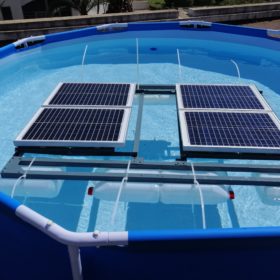
Moroccan researchers have set up a new floating PV test bench. They claim floating solar arrays offer better power yields than rooftop and ground-mounted PV systems, with lower module operating temperatures.
Exoskeletons for solar panel mounting
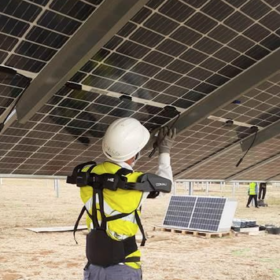
Endesa, the Spanish unit of Italian power group Enel, is using a new technology in the construction of three solar parks in southern Spain.
Enel and French PV institute achieved an efficiency of 25.0% for a heterojunction solar cell
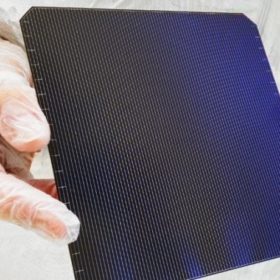
The solar cell calibration laboratory ISFH CalTeC has certified the efficiency of the cell, which was made with a standard M2 wafer.
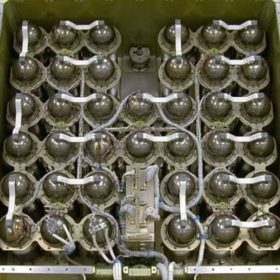
US startup to shake up battery market with metal hydrogen tech
EnerVenue launched with $12 million in seed funding, boasting advantages over lithium-ion in performance, price, operability in extreme weather, and decades of use in the aerospace industry.
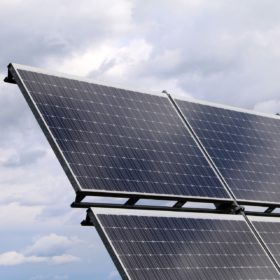
New MPPT algorithm for bidirectional inverter design
A newly proposed inverter design relies on a solar charge controller featuring maximum power point tracking. It is based on an artificial fish-swarm algorithm, which offers high convergence speeds, flexibility, fault tolerance, and accuracy.
