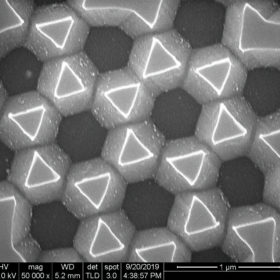
Nanostructures for ultrathin flexible wafer
Scientists in South Korea combined two processes to etch a nanostructure of tiny pyramids onto the surface of a silicon wafer. As well as trapping more light and increasing the cell efficiency, the group claims that its nanostructure improves the mechanical flexibility of the cells. This could potentially allow for the use of much thinner silicon wafers than is currently possible in production.
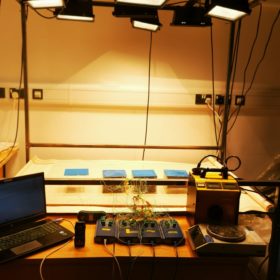
Cooling PV panels with seawater
An Anglo-Egyptian research group has developed a passive cooling method based on saturated activated alumina, with saline water as a cooling agent.
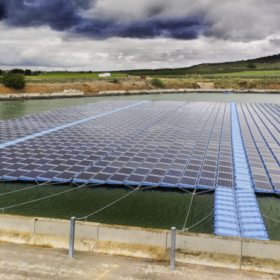
Mounting structures for floating PV from Spain
Spanish engineer Isigenere has developed floating PV mounting structures based on virgin high-density polyethylene and says the manufacturing process, which features plastic injection, can produce around 1 MW of the product every five days.
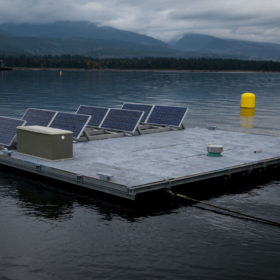
Active cooling for PV modules in floating arrays
Saudi Arabian and Pakistani scientists have created a serpentine cooling block structure to improve the efficiency of PV panels in floating solar projects by around 1.5%. The cooling block can be filled via a low-cost, 15.6 W commercial 12 V DC water pump with cool water.
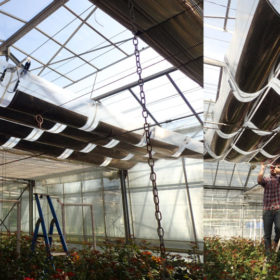
Photovoltaic shade for greenhouses
French start-up Solar Cloth has secured a patent for a PV shade screen for solar greenhouses.

NREL scientists estimate global potential of hydro-linked floating PV at up to 7.5 TW
The U.S. based researchers said linking solar with hydro in a full hybrid system configuration may result – at best – in the deployment of 7,593 GW for an estimated annual power generation of 10,616 TWh and a 20% reservoir coverage. And combining solar with hydro in this way brings further benefits, including improved system operation at different time scales, more opportunities for storage thanks to pumped hydro, increased utilization rates of transmission lines, reduced PV curtailment, and lower interconnection costs and water evaporation.
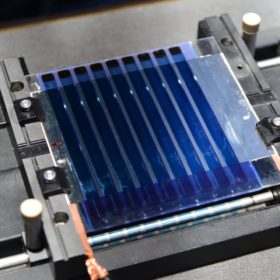
More efficient large-area organic solar cells with spin coating
Researchers in South Korea have used the process to increase performance and the replicability of large-area organic cells. The method was used during film formation to speed up solvent evaporation.
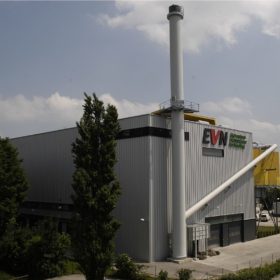
Power-to-heat for district heating may drive wind and solar
Researchers say the technology could help drive clean energy deployment in countries with limited grids or in isolated, coal-based energy systems. According to their model, Kosovo could see a strong increase in wind and PV capacity if power-to-heat is coupled with thermal energy storage for fixed-capacity district heating.
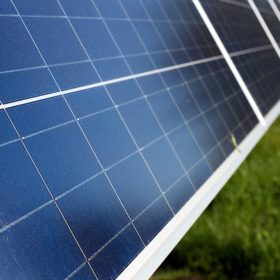
Titanium oxide nanofluid-based cooling technique for PV panels
Indian and Malaysian scientists have developed a new cooling system featuring an assembled back-channel attached on the rear sides of solar panels, to channel flows of titanium oxide and water. They used a 0.6% nanofluid concentration – the optimum value of nanoparticle concentration in water.
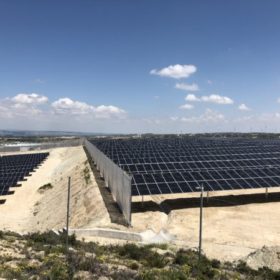
Windbreak walls for solar parks
Iasol has developed a new way to protect solar plants in windy conditions. The Spanish developer said the solution barely has an impact on project costs or output, while preventing expensive damages.
