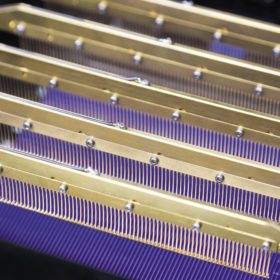
Weekend Read: Connecting HJT
The application of busbarless cell interconnection approaches could unlock the potential of heterojunction (HJT) technology, primarily by reducing the historically high silver usage of negatively-doped, “n-type” cell technology. As HJT manufacturing increases, a wave of applications may very well be on the horizon.
Chinese PV Industry Brief: Tongwei, Canadian Solar announce new factories
Tongwei is planning a cell and module factory in the Sichuan province, while Canadian Solar is setting up a new wafer factory in the Jiangsu province.
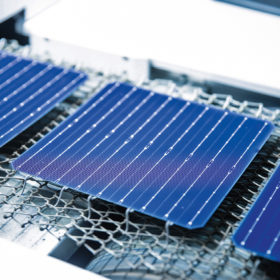
LeTID minimal issue for gallium-doped Czochralski silicon PERC products
Scientists from Trina Solar, Longi, Fraunhofer ISE, and other entities have looked at light and elevated temperature-induced degradation (LeTID) in gallium-doped Czochralski silicon (Cz-Si:Ga) PERC cells. They have found little relevant degradation.
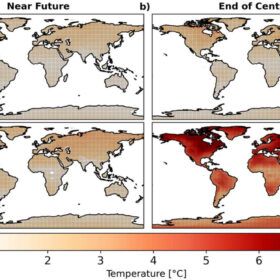
Emissions, aerosols negatively affect PV productivity, say Australian engineers
A study by engineers at Australia’s University of New South Wales (UNSW) shows that aerosols and greenhouse gas emissions reduce the productivity of PV installations, with variations across regions.
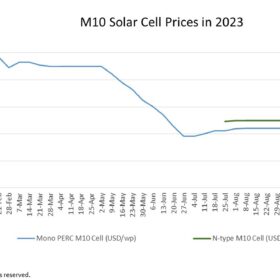
M10 solar cell prices dive to new record low
In a new weekly update for pv magazine, OPIS, a Dow Jones company, provides a quick look at the main price trends in the global PV industry.

Photovoltaics for marine wildlife telemetry devices
A US research team has tested mini solar modules in marine data collection devices, using animal hosts for water column profile measurements. The findings suggest that submarine PV can effectively operate in these applications at depths of up to 22 meters.
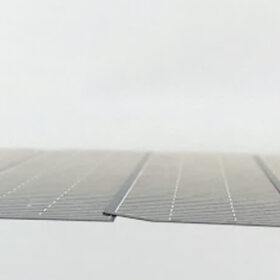
Perovskite-silicon tandem solar cells have practical efficiency potential of 39.5%
Researchers at Germany’s Fraunhofer ISE have provided guidelines for future research on perovskite-silicon tandem solar cells by identifying the most significant loss mechanisms at the perovskite/ETL interface, in the series resistance, and in light management.

Hanwha Qcells shuts down 3.5 GW solar factory in South Korea
Hanwha Qcells has closed its 3.5 GW solar factory in South Korea as part of plans to optimize its PV module production capabilities amid a stagnant domestic solar market.
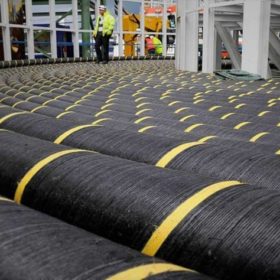
TotalEnergies acquires minority stake in UK-Moroccan solar-wind interconnector
TotalEnergies says it has invested GBP 20 million ($25 million) in Xlinks’ 11.5 GW hybrid solar and wind facility in southern Morocco. Xlinks aims to transport power to Great Britain through 3,800 kilometers of underwater cables.
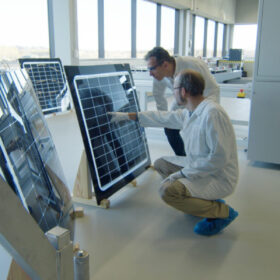
Imec integrates silicon heterojunction solar cells into curved surfaces
Imec has successfully integrated silicon heterojunction PV cells into curved surfaces, resulting in a 6% efficiency increase compared to passivated emitter and rear contact (PERC) half cells. The cells are suitable for applications in vehicle-integrated and building-integrated PV (BIPV).
