
OPIS Global Polysilicon Marker inches higher as US Section 232 uncertainty lingers
In a new weekly update for pv magazine, OPIS, a Dow Jones company, provides a quick look at the main price trends in the global PV industry.

Inverted perovskite solar cell based on self-assembled monolayer achieves 26.92% efficiency
Researchers in China have developed an inverted perovskite solar cell approaching the 27% efficiency threshold. The device incorporates a specially designed self-assembled monolayer that passivates perovskite defects and enhances efficiency.
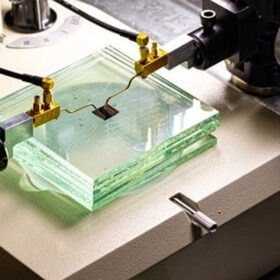
U.S. scientists build graphene-based solar cells than can charge supercapacitors
The solar cells combine multilayer graphene with silicon wafers, harvesting both solar and kinetic energy for continuous operation. Tests show the cells can autonomously power supercapacitors embedded in a temperature sensor.
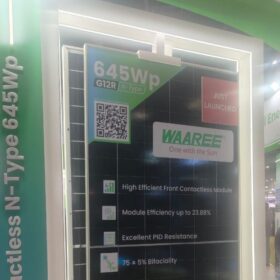
Waaree unveils 645 W back contact solar module with 23.88% efficiency
Waaree Energies has entered the back contact module business with a TOPCon dual-glass module. The new product is based on cells with G12R format.
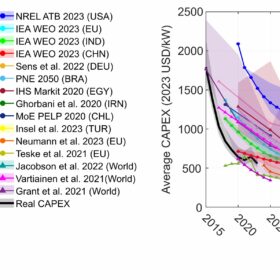
The future arrived early: Why our energy cost forecasts need to catch up
While solar modules and batteries have become icons of rapid progress, most energy models are still stuck in the past. A new global analysis shows that the cost of renewable energy has fallen far faster than expected. Solar PV, wind power, and battery technologies have already reached price levels that models once placed many decades ahead – a misplaced pessimism that risks misdirecting billions in climate investment and could distort long-term defossilization strategies.
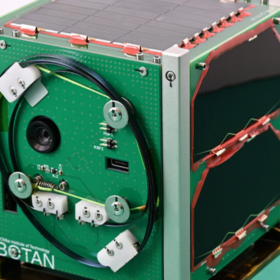
Idemitsu developing CIGS solar modules for satellites
Japan’s oil giant Idemitsu Kosan and U.S.-based Source Energy Company announced a collaboration to develop copper indium gallium-selenide solar modules and arrays for satellite and space applications.

Outdoor testing identifies factors contributing to perovskite solar cell degradation
Tests conducted by a research team in outdoor environments in Spain and Poland have demonstrated a strong correlation between perovskite solar cell degradation and the combined effects of climatic and operating conditions. The scientists found that open-circuit operation accelerates degradation, whereas operation at the maximum power point and under short-circuit conditions has a lower impact.

Bangladesh opens testing lab to certify solar module quality
The Bangladesh Standards and Testing Institution (BSTI) says its new solar module testing laboratory in Dhaka marks a major step toward enforcing quality standards and supporting the nation’s export ambitions.
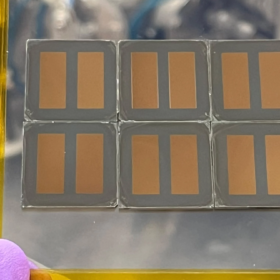
NTU achieves high stability in 25.1%-efficient inverted perovskite solar cell
Researchers at Nanyang Technological University have demonstrated a method to integrate chemically inert low-dimensional interface materials into the fabrication of inverted perovskite solar cells. Their prototype solar cells retained over 93% of the initial power conversion efficiency of 25.1% after 1,000 hours of operation, and 98% after 1,100 hours at 85 C.

Chinese PV Industry Brief: Major solar manufacturers report steep Q3 losses
Longi Green Energy, JinkoSolar, and JA Solar each posted significant third-quarter losses amid continued price declines and high inventory levels, raising concerns among analysts about oversupply and margin pressure across the PV supply chain.
