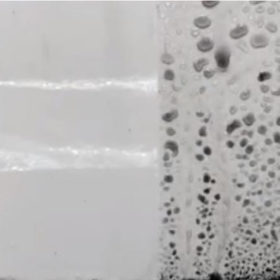
French consortium develops self-cleaning solar module coating
French chemical company Axcentive and solar module manufacturer Photowatt have developed a PV panel coating based on photoactive nanotechnology. The coating relies on a super-hydrophilic surface that makes the water spread out on the module surface immediately, thus avoiding light scattering effects upon rain.
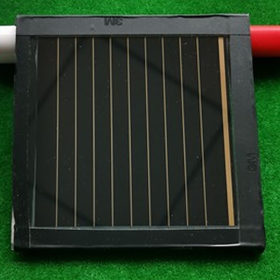
Formamidinium-cesium perovskite solar cell with 24.25% efficiency
Developed by scientists in China, the cell was used to fabricate a 20.5%-efficient mini perovskite module. A dual-functional additive was applied to regulate the crystallization and defects of the formamidinium-cesium perovskite film.
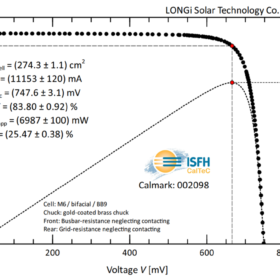
Longi achieves 25.47% efficiency for gallium-doped p-type heterojunction solar cell
The result, confirmed by Germany’s Institute for Solar Energy Research Hamelin (ISFH), was achieved on a heterojunction solar cell based on an M6 wafer.
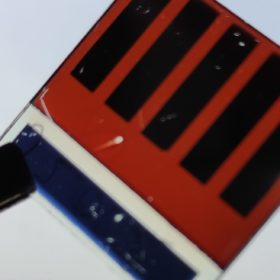
Tin perovskite solar cell with operational stability of over 1,300h
Scientists in Spain have built a 10.61%-efficient tin perovskite solar cell with improved open-circuit voltage and stability. The device was fabricated with formamidinium tin iodide (FASnI<sub3), sodium borohydride (NaBH4) as a reducing agent, and a bulky secondary ammonium cation of small size known as dipropylammonium iodide (DipI).

Ultrathin photovoltaic silicon membrane with 65% light absorption
A Dutch-British research group is developing a 1μm crystalline silicon membrane with a remarkable optical performance and a hyper-uniform pattern design. A simulation of the device was theoretically able to achieve an absorption equivalent photocurrent of 26.3mA/cm2.

Solar starts strong in the US, growing 40% year over year in January
US solar generation reached new heights despite a year of challenges. Plus, pv magazine discusses “renewable” vs. “sustainable.”

US government to move forward with PV anti-circumvention investigation
The announcement of a new anti-circumvention investigation brings the US solar industry closer to what has been described as a worst-case scenario for companies that account for 80% of the country’s solar cell imports, with no domestic manufacturing capacity to alleviate the pressure.
IntriEnergy secures solar patent in India
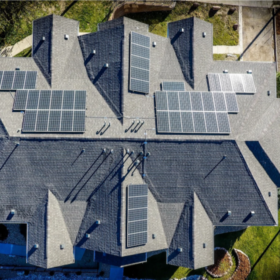
US-based IntriEnergy has secured a patent for its PV cell tech platform that can increase the energy output of solar panels by up to 60% without increasing the panel size.

PV-powered refrigerated tank for milk storage
The autonomous system is designed for small companies that produce milk, juice, beverages, or food products, it and can reach four degrees Celsius in three hours with an external temperature of 30 degrees.
Quantifying loss-mitigating effects of PV warranty insurance
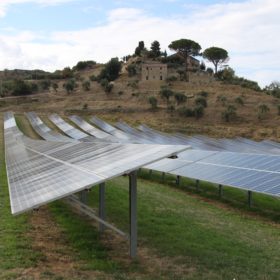
German consultancy VDE Renewables and global reinsurer Munich Re have outlined an approach to quantify the impact of risk mitigation measures applied to PV projects, as well as the advantages that may be derived by relying on an insurance solution. Risk mitigation expert Ulrike Jahn has spoken with pv magazine on how the new approach was shaped and what kind of performance issues should be taken into account by PV asset owners.
