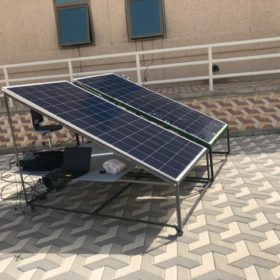
Solar module cooling techniques for the desert
Saudi scientists have tested several cooling technologies for solar panels and have found that active techniques work better than passive ones under harsh climatic conditions. The most effective one consists of a system based on four heat pipes immersed in a box of liquid, as liquid bulk, integrated with the back of the solar panel.
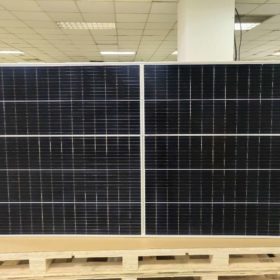
Trina Solar achieves 23.03% efficiency for 210 mm PERC solar module
The result was confirmed by Germany’s TÜV Rheinland and TÜV Nord.
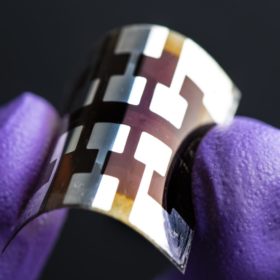
Do engineers dream of solar panel efficiency?
A true next generation of solar cell technology is upon us. It is time to contemplate the benefits.
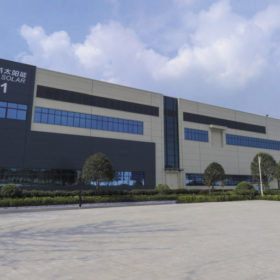
Chinese PV Industry Brief: Tongwei plans 200,000 MT polysilicon factory
The new polysilicon factory will be located in Leshan City and will be built thanks to an investment of $2.1 billion.
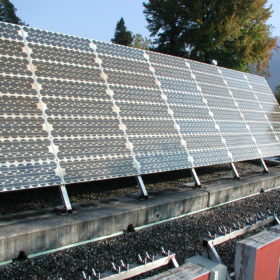
Exploring the depths of Europe’s oldest grid-connected PV system
A 10 kW PV system has been feeding electricity into the Swiss power network since 1982. A research team has investigated the performance of the array’s first 35 years of life and has found that solar modules can target – at least in temperate climates – service lifetimes of 35 years, and that the bill of materials matters, a lot!

All solar cell efficiencies at a glance
The research group led by Professor Martin Green has published Version 58 of the Solar cell efficiency tables. He spoke with pv magazine about the criteria with which these tables are compiled and the importance of result certification by independent third parties.
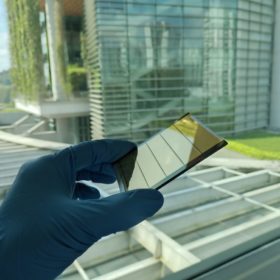
Proper recycling could help perovskite modules to outcompete rivals
Proper recycling strategies for perovskite modules could ensure sustainability and improve energy payback times, according to US researchers. They claim that the best recycled perovskite cell architecture could produce an energy payback time of about one month, versus 1.3 to 2.4 years for crystalline silicon modules.
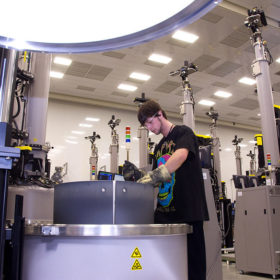
Chinese PV Industry Brief: Zhonghuan lowers wafer prices, Golden Glass sets up 1.2 GW HJT module line
Manufacturer Golden Glass is planning to set up a 1.2 GW heterojunction cell and module production line in Jiangsu province and Trina Solar and China Petrochemical Corp will work to reduce the carbon footprint of the latter’s gasoline stations.
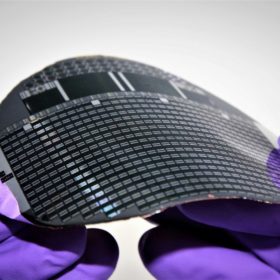
Fraunhofer ISE unveils 68.9%-efficient III-V solar cell for laser energy transmission systems
The German research institute said the gallium arsenide cell has achieved the highest efficiency to date for the conversion of light into electricity.
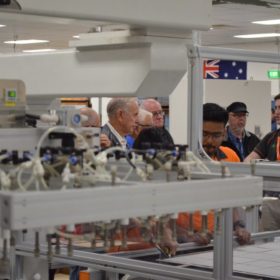
Australian PV module maker sets sights on world stage
Australian PV module manufacturer Tindo Solar says it is confident that it can compete with the world’s biggest manufacturers, as it recently secured fresh state funding.
