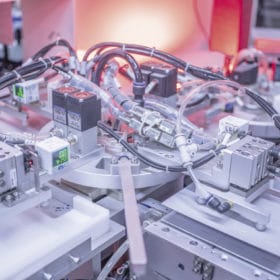
JinkoSolar announces perovskite cell technology platform promising efficiencies close to 30%
The announcement was given by the Chinese module maker in its financial statement for the first quarter of the year. The company also stated it shipped 5.35 GW of PV products in the period from January to March and that its revenue and profits declined by 6.4% and 21.7% year-on-year, respectively.
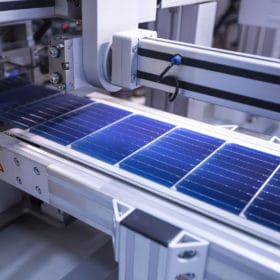
Chinese PV Industry Brief: New solar glass factory in Jiangsu, Longi maintains wafer prices unchanged
Triumph Group is planning to build a $1.71 billion PV glass factory in Suqian City, Jiangsu Province. Longi has maintained unchanged the prices of its wafers for July.
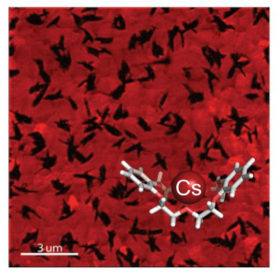
A crowning achievement for perovskite stability
Scientists in Switzerland demonstrated a new type of nanoscale doping for perovskite solar cells. By both improving stability and reducing the chance of the cells leaking any toxic lead into the environment, the discovery addresses two of the largest remaining challenges to the development of the promising class of cell materials.
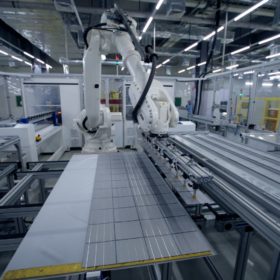
India could add 13.75 GW of PV module capacity by late 2022
The Indian government’s efforts to restrict PV equipment imports and expand domestic manufacturing are starting to bear fruit.
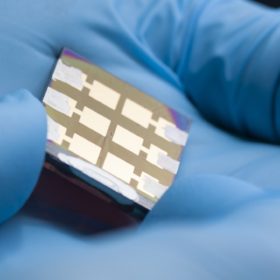
Lead halide perovskite cell based on benzodithiophene cation achieves 14.7% efficiency
Swiss researchers sought for the first time to replace phenylethylammonium (PEA) with benzodithiophene (BDT) in cations for perovskite cells. The latter showed improved stability and ensured a power conversion efficiency that was 1% higher than that of its counterpart.
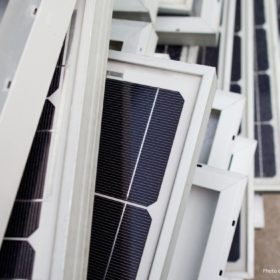
Canberra moves forward with new PV module recycling rules
The Australian federal government’s call for the solar industry to address the issue of PV module waste has coincided with new plans by the Australian Capital Territory government to look at new panel recycling options.
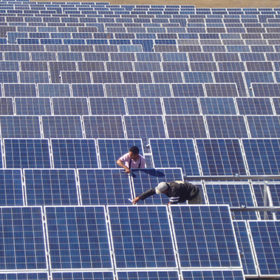
Risen Energy plans 3 GW cell, module factory in Malaysia
China-based Risen Energy is expanding its global footprint with plans to construct a $10 billion production facility in Malaysia.

‘World’s cheapest wafer’ maker plans 2 GW Indian cell and wafer fab
U.S. business 1366 Technologies is looking for Indian module manufacturing partners as it plans to bring its ‘direct wafer’ production technique to the country. The company uses molten silicon to form wafers rather than sawing ingots, thus eliminating dust waste and speeding up the process.

US government bans products from four Xinjiang-based solar manufacturers
The four manufacturers are Hoshine Silicon, Daqo, East Hope, and GCL New Energy Material.

Trina announces first shipments of 670 W Vertex modules
The panels will be used for the first 100 MW phase of a 1 GW solar park under construction in in Dachaidan, Qinghai, western China.
