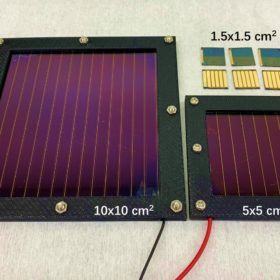
New perovskite material for 23.5%-efficient solar cell
Researchers in Japan have found a new way to fabricate one of the most promising perovskite materials for PV application — the α-formamidinium lead iodide known as α-FAPbI3. With a pre-synthesized version of this material, they were able to produce a cell with a power conversion efficiency of 23.5% and a lifespan of more than 2,000 hours.

Solar manufacturing tax credit introduced in the U.S. Senate
The Solar Energy Manufacturing for America Act would establish a tax credit for domestic solar manufacturers in an effort to boost the U.S. solar supply chain, create American clean energy jobs, compete with Chinese manufacturers, and support energy independence.

Solar energy collectors… grown from seeds!
Rice University engineers produced “near-perfect” 2D perovskite crystals for photovoltaic applications, grown from seeds.
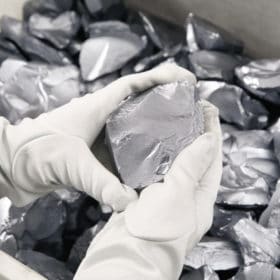
Jinko and JA Solar to invest $100m in 100,000-ton polysilicon fab
The two solar manufacturers will get priority access to polysilicon produced at the planned fab in Inner Mongolia, which developer Xinte Energy has said will be fully operational by June 2023.
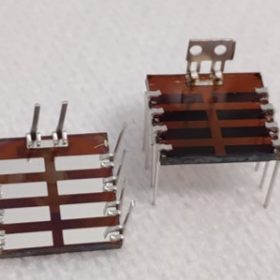
Black perovskite solar cell with 15% efficiency via thermal evaporation
The cell exhibited an open-circuit voltage of 1.1 V and was able to retain around 90% of its initial performance after 215 days of exposure to dim light at room temperature. According to its creators, this performance and the notable stability were ensured by the thermal evaporation technique used for depositing the perovskite layers onto the cell.

Chinese PV Industry Brief: 50 GW wafer factory commissioned in Qinghai province
Furthermore, Zhonghuan Semiconductor has slightly reduced its wafer prices, while Longi has maintained them unchanged. Flat Glass is raising funds to support the construction of a new glass factory with a total annual capacity of 750,000 metric tons.

Flexible perovskite solar module with 10.5% efficiency
The methylammonium-free inverted solar module was built on a flexible substrate made of polyethylene terephthalate (PET). A hole transporting material made of poly(triarylamine) (PTAA) and a double-cation cesium formamidinium (CsFA) perovskite layer were deposited through blade-coating and nitrogen-assisted blade-coating.

Roll-out solar arrays installed in successful NASA spacewalk
The first new ISS Roll-Out Solar Array (iROSA) has been installed on the International Space Station.

Saule Technologies opens perovskite solar cell factory in Poland
The Polish perovskite solar cell specialist claims to be the first company in the world to have commissioned commercial production of the technology.

JinkoSolar, Longi, JA Solar claim 182mm modules offer lowest LCOE for utility scale solar
In a white paper, the three Chinese module manufacturers have reiterated the well-known refrain “bigger is not always better.” Experts from the three companies compared the BoS costs of 182mm-wafer-based modules and 210mm products, and found that the former have a slight advantage in racking, foundation, and land costs.
