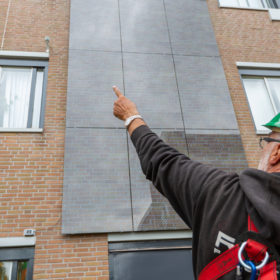
Facade solar panels with ‘mimic design’
Dutch startup Solar Visuals and the Netherlands Organisation for Applied Scientific Research (TNO) have developed new “mimic design” facade modules that reproduce the features of building surfaces. Lenneke Slooff-Hoek, a senior scientist for TNO, told pv magazine that the panels can be made in any size or color at 13% efficiency, adding that they have a partly transparent colored layer made of small dots.

Ikea’s full home solar offer arrives in Australia
Ikea has launched its turnkey home solar offer in Australia, making it the first market outside of Europe in which consumers can purchase home solar kits from its website. The company has partnered with Solargain to bring solar to as many Aussie rooftops as possible.

US added 3.6 GW of solar in Q1
Utility-scale solar strength will cover for residential and rooftop PV weakness in 2020, according to SEIA and WoodMac.
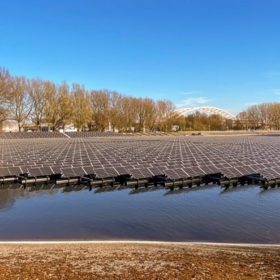
Another floating solar park goes online in the Netherlands
Dutch water supplier Evides Waterbedrijf has commissioned a 1.6 MW floating PV plant at one of its facilities near Rotterdam. It is now considering the construction of more floating solar plants on three other reservoirs, including a 350-hectare water surface.
New 3.6 GW PV-powered hydrogen project announced in Australia
Austrom Hydrogen, a newcomer to the Australian renewable energy scene, has unveiled plans to develop a large solar project, battery storage system, and hydrogen generation facility in Queensland.
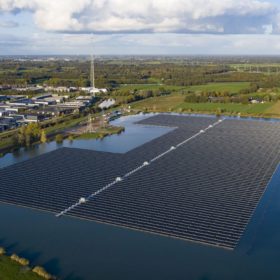
Implementing standards in floating PV
Norwegian consultancy DNV GL has gathered together big energy players, floating PV specialists and project developers into a consortium that will aim to define recommended practices for the floating solar business. Among the 14 participants are some big players in the field including EDP, EDF and Equinor, as well as French floating technology provider Ciel & Terre.
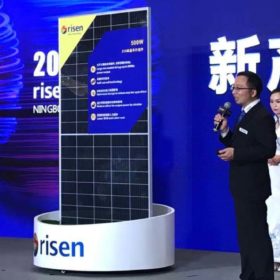
Chinese PV Industry Brief: a 15 GW factory, new standards and solar glass output
Risen Solar has unveiled plans for a 15 GW cell and module fab in Yiwu City, Zhejiang province and China South Glass is fundraising for a PV glass factory in Anhui province. Such growth, however, may be slowed by the introduction of new standards by the government.
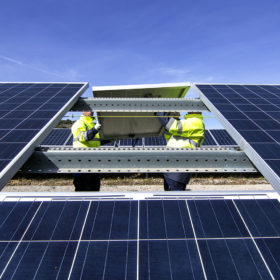
Another PPA for large scale solar in France
The deal is the fourth power purchase agreement secured by Voltalia in its homeland. French retailer Auchan will buy the electricity under a 20-year contract.
Cooling PV modules with passive technique based on finned heat sink
A Pakistani research team has assessed the performance of a passive heat sink cooling technique in two different configurations: one using rectangular fins and one based on circular fins. The rectangular configuration was the best in terms of heat rejection. Modules mounted with this solution had a 6 C lower temperature than modules without cooling systems.
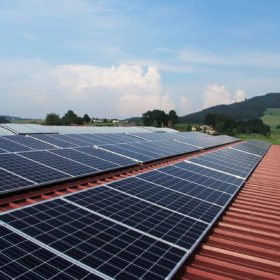
France assigns 152 MW in commercial and industrial PV tender
The final average price for power generated by solar systems with capacities ranging from 100 kW to 500 kW came in at €96.49/MWh. The price for installations ranging in size from 500 kW to 8 MW was €86.17/MWh.
