
Novel blockchain-based virtual utility for P2P PV trading
Researchers from Canada’s Western University have developed an open-source, blockchain-based virtual utility for peer-to-peer (P2P) solar trading, using smart contracts to save up to $1,600 (US dollars) for 10 homes in simulated scenarios.
How much shade is enough?
Researchers have covered part of a rooftop solar plant with a different numbers of shading cloth layers to measure their power, current, and voltage. They have been able to identify a point after which the value of system current and maximum power is no longer sensitive to shading heaviness.
Heliostat field-integrated PVT system supported by organic PCM
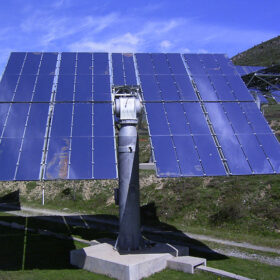
Scientists have used stearic acid and a combination of stearic acid and carbon black to increase thermal conductivity in a photovoltaic-thermal system linked to a heliostat field concentrator. From a temperature of 30 C at the inlet, they were able to heat the water to up to 59 C.
New research finds solar module anti-reflective coatings may reduce LCOE by over 2%
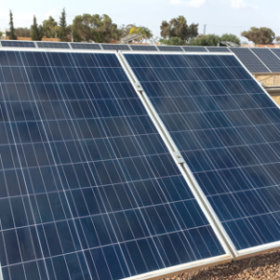
Researchers in Morocco have examined the effects of an anti-reflective coating on solar panel performance under desert conditions and have found that it enhanced both the annual performance ratio and the energy yield by 2% and 5.5%, respectively. They have also found it to be durable and able to withstand dry cleaning methods under accelerated testing.

EDF Renewables wins tender for largest PV plant in Israel
EDF Renewables says it has won a tender to build and operate Israel’s largest PV plant, a 300 MW project near Dimona, with a bid under $0.019/kWh – the lowest price ever in the Israeli market.

The impact of semi-transparent solar modules on agrivoltaics yield
Researchers have conducted a field study across two growing seasons, growing different kinds of vegetables under three types of modules with 40%, 5%, and 0% transparency. Their work is the first replicated research experiment that evaluates module transparency in an irrigated vegetable field setting.
East-west vertical PV as an antidote for soiling in desert climates
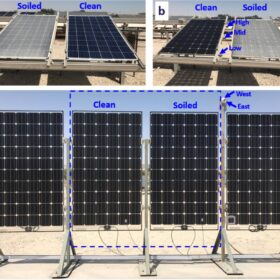
New research from Qatar shows that east-west-oriented vertical PV installations can significantly help reduce soiling in desert climates. The scientists found that PV power generation can be up to 9% higher in vertical systems compared to conventional arrays.

Atess Power releases 100 kW/150 kW commercial inverters
Atess Power says it has developed 100 kW/150 kW commercial inverters with two maximum power point trackers (MPPTs), a 600 V to 900 V battery voltage range, and 10 milliseconds on/off grid transfer capability.
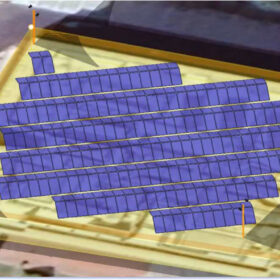
New direct lightning protection design for east-west rooftop PV systems
Scientists in the Emirates have developed a novel lightning mast layout that reportedly eliminates shading effect on PV panels. The proposed approach also addresses earth grid requirements under varying moisture conditions.
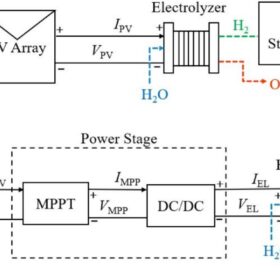
Direct vs. indirect coupling in PV-driven hydrogen generation
Researchers in Spain have made a comparative analysis of annual PV-powered hydrogen production for direct and indirect configurations and have found that indirect systems not only produce more hydrogen but also that they show higher resilience to module power losses.
