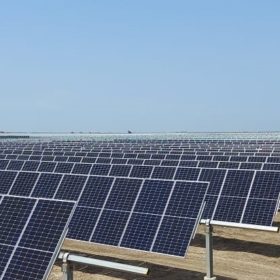
India added 3 GW of solar in first quarter
India’s cumulative installed solar capacity stood at 52 GW at the end of March.
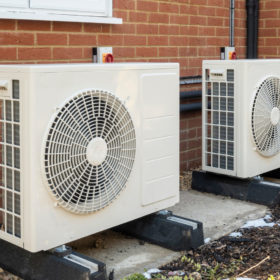
What are upfront and lifetime costs of heat pumps in the US?
The “all electric” movement is shining new light on heat pumps. A recent survey looks at their costs in terms of replacements for heating and air conditioning systems.
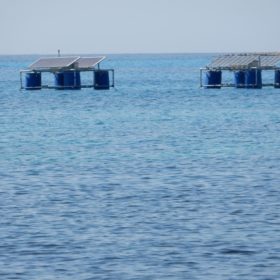
Chinese province seeks proposals for 11.5 GW of offshore PV
The authorities in China’s Shandong province have identified 10 offshore sites close to the coastline where 11.5 GW of solar projects could be constructed. Binzhou, Dongying, Weifang, Yantai, Weihai, and Qingdao are some of the preferred areas.
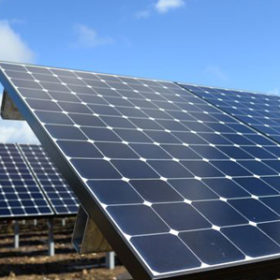
Romania’s largest solar project for self-consumption
Engie Romania is building an 8 MW solar park to power the operations of Saint-Gobain Romania.

Czechia earmarks $43.4 million for solar rebates
PV developers in Czechia can apply for solar rebates until Aug. 31. Solar-plus-storage projects will also be able to participate.
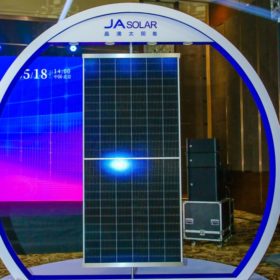
JA Solar introduces n-type solar panel with 22.4% efficiency
JA Solar said that the smallest solar panel in its new n-type product line has a power output of 435 W and a power conversion efficiency of 22.3%. The largest module in the series has an efficiency rating of 22.4% and 625 W of nominal power. Their temperature coefficient is -0.30% per degree Celsius.
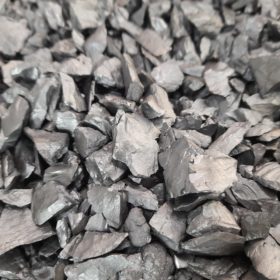
Chinese PV Industry Brief: Geely opens polysilicon plant
Automaker Geely has commissioned a new polysilicon factory in northern China, while ET Solar has opened a new 5 GW wafer factory in Vietnam. Poly giant GCL Technology, meanwhile, has confirmed that its board might issue common stock for a Chinese listing.

Shell to build 100 MW hybrid wind-solar project
Shell plans to construct a 50 MW solar park and a 50 MW wind farm in the Netherlands. It said the two installations will share the same connection point.
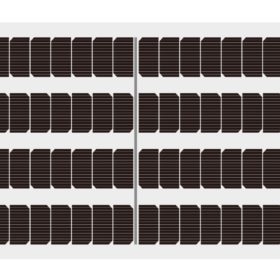
JinkoSolar showcases 13.08%-efficient transparent TOPCon solar module for BIPV, agrivoltaics
The new solar module can be purchased with different levels of transparency, depending on the project, with light transmittance ranging between 30% and 40%. It has a power output of 245 W to 300 W and a temperature coefficient of -0.30% per C.
Stadium in Senegal hosts 2.3 MW solar plant
Turkish developer Citus Power built the solar array with Sungrow inverters and Trina modules. It is able to operate in both on- and off-grid mode.
