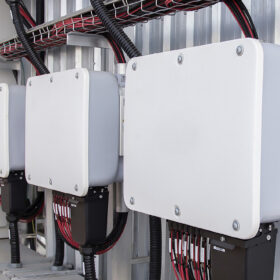
Improving solar inverter design with silicones
Inverters must withstand the high levels of heat generated when operating, otherwise system performance and reliability could be at risk. Cody Schoener of Dow Performance Silicones argues using silicone-based materials for inverters can improve thermal management and fire protection, while offering thermal stability, environmental resistance, electrical isolation and support for operational efficiency.
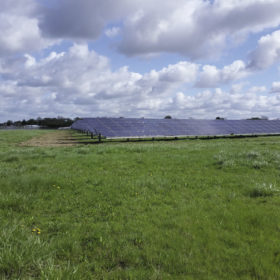
UK’s largest solar project approved, joins 2.1 GW cluster
Development consent granted for 1,400 hectare Tillbridge Solar Project. The 500 MW solar plant is the 17th energy project to secure final approval through the UK government’s nationally significant infrastructure project (NSIP) pipeline since July 2024 and the fourth in the local area.
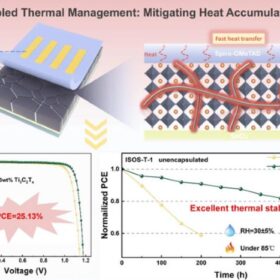
Perovksite solar cell based on MXene achieves 25.13% efficiency
A Chinese research group claims to have achieved remarkable efficiency and stability in a solar cell based on a perovskite absorber incorporating MXene, a novel type of 2D material known for its excellent conductivity, chemical stability, and thermal resilience. The device reportedly retained 80% of its initial efficiency after 500 hours.

Supermarket EV chargers in Berlin could improve efficiency by over 250%
German researchers say shared-use and digital brokerage models could lift utilization and profitability of supermarket EV charging stations by up to 255%.

Cadmium telluride vs. crystalline silicon in agrivoltaics
Canadian researchers investigated how the transparency of cadmium telluride and crystalline silicon solar panels affects lettuce growth in agrivoltaic systems. They found that 69%–transparent silicon panels increased lettuce yield by 3.6%, whereas cadmium telluride panels led to a reduction in yield.

Novel swapping technique for partially shaded PV systems
Researchers in India have developed an algorithm for quadrant swapping in PV arrays, enabling the creation of new quadrants containing either shaded or unshaded modules. The method was tested across ten shading scenarios with varying irradiation levels and demonstrated “superior” performance compared to conventional approaches.
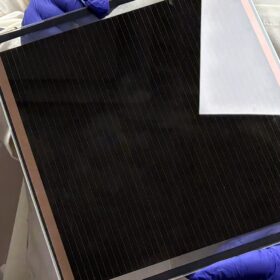
Sofab Inks achieves 22.2% efficiency in mini inverted perovskite solar panel
The U.S. startup said the 30 x 30 cm perovskite solar cell device featured its tin oxide electron transport material produced in a sheet-to-sheet slot die coating process.
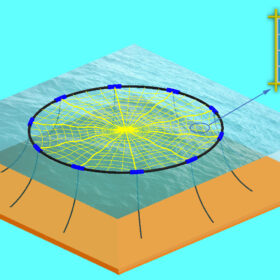
Floating photovoltaics based on spiderweb design
Scientists in the United Kingdom have developed a new web-inspired concept for floating PV farms, modeled after spider webs. The system is said to be particularly suitable for spiral and radial configurations, as well as for deployment between offshore wind farms.
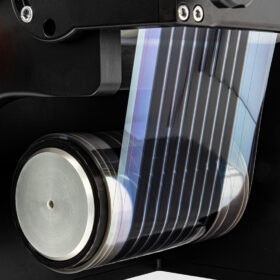
Market trust key for perovskite solar commercialization
In a new perspective paper, researchers from Dresden University of Technology and Denmark’s InfinityPV analyzed scientific research and more than 100 companies involved in organic PV and perovskite solar cell manufacturing. Their findings show that the commercialization of these technologies depends on the PV industry’s ability to increase financial transparency.
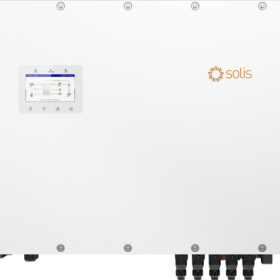
Solis unveils 75–125 kW hybrid inverter for C&I solar
The Chinese manufacturer said its new inverters can deliver 160% overload for 200 ms in off-grid mode, ensuring stable startup of heavy loads. The IP66-rated products feature a maximum efficiency of 97.6% and a European efficiency of 97.2%.
