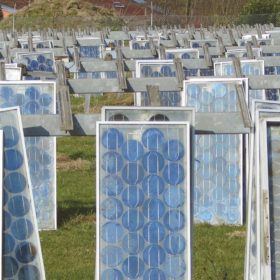
India could have 2.95bn tons of solar waste by 2047
Researchers led by the Indian Institute of Technology Delhi have projected the waste expected from end-of-life solar panels and related components. They assumed 347.5 GW of total installed solar generation capacity would be reached this decade. The academics said the waste would include critical metals worth around $645 trillion, 70% of which could be recovered.
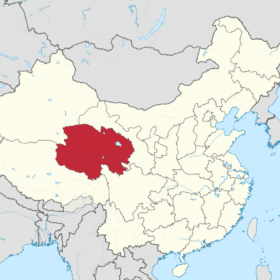
Chinese PV Industry Brief: Earthquake disrupts wafer production in Yunnan and Qinghai
Solar manufacturers Longi and Zhonghuan Semiconductor have reported output at their factories in the two provinces has been reduced by earthquakes that happened on Friday night and before dawn on Saturday. Elsewhere, module maker Jolywood has announced the signing of an agreement with the city government of Taiyuan, in Shanxi province, to build a TOPCon solar cell fab with a 16 GW production capacity.

Hanwha Q Cells unveils 495 W solar panel with 21.4% efficiency
The Q.Peak Duo XL-G10.3 panel is currently the largest and most powerful product manufactured by the South Korean module maker. It is based on 156 monocrystalline ‘Q.antum’ half cells and is the company’s first panel relying on M6 wafers.
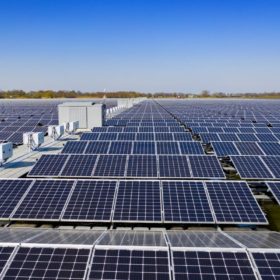
Construction begins on Europe’s largest floating PV plant
The plant is being built by Dutch developer Groenleven on a former sand extraction lake in the northern Netherlands. The company’s project manager for floating PV, Willem Biesheuvel, told pv magazine about its approach to deploying floating arrays always with a west-east orientation, which he claims ensures more stability and resistance to wind and waves.

CEA-Ines achieves 19.2% efficiency for flexible perovskite solar cell
The cell was fabricated with a flexible substrate made of indium tin oxide (ITO) and polyethylene terephthalate (PET). The device was tested through a damp heat test and showed it can retain around 90% of its initial efficiency after 800 hours.
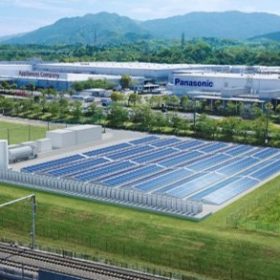
Panasonic combines hydrogen fuel cell generators with PV and storage
The pilot project is combining hydrogen fuel cell generators with a combined capacity of 500 kW with a 570 kW solar array and 1.1 MWh of lithium-ion batteries. It is planned to come online in the spring of 2022.
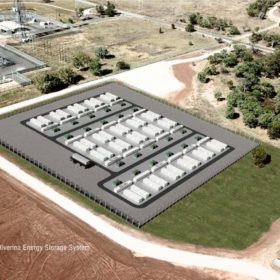
Eastern Australia to host 100 MW / 200 MWh big battery
Murrumbidgee Shire in the New South Wales’ Riverina region is set for a big battery and big flexibility after Edify and Shell Energy came together on a deal that will see the realisation of the Riverina Energy Storage System.
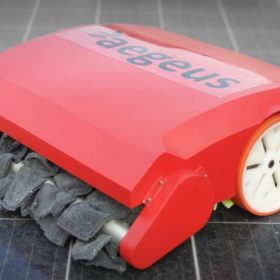
Water-free, portable cleaning bot for rooftop solar
India’s Aegeus Technologies has developed an autonomous, water-free cleaning bot for rooftop solar installations. The bot weighs 5 kg (with battery) and can be operated remotely through a web-based app. It uses an air wash technology to clean the panels, ensuring no need for water or any harmful chemicals.
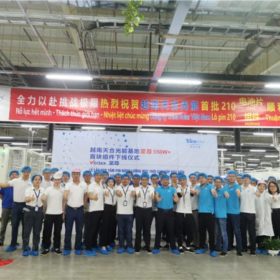
Trina Solar begins production of 550 W modules at Vietnam facility
Trina Solar broke ground on its Thai Nguyen plant in December, and completed construction in five months.
Global solar supply chain under scrutiny
The discussion about the extent to which forced labor exists in the solar value chain continues. A video, a university report, a ministerial response and a parliamentary machinations formed notable developments of the debate last week.
