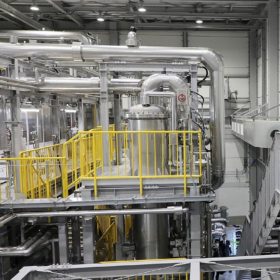
Breaking the rules to foster green hydrogen innovation
The Danish Energy Agency has granted permission, to two power-to-X specialists, for the development of innovative projects without having to comply with the country’s energy legislation. This exemption is part of an upcoming pilot scheme to support new clean energy technologies, including green hydrogen.
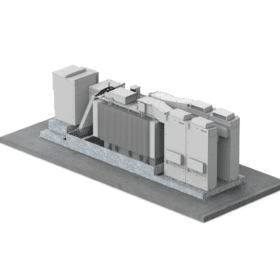
Ingeteam unveils power station for string inverters
The Ingecon Sun String Station reaches 6.4 MW of medium voltage output and is supplied as a “turnkey” solution. It was already installed in solar plants located in Toledo and Huesca.

Big solar-plus-storage comes to Taiwan
Taiwanese module maker URE Corp is planning to link a 150 MW solar plant to a 15 MW/15 MWh storage facility.

Legal challenge to Ukraine’s retroactive FIT cuts
Lithuanian-owned solar developer Modus Energy International is reportedly seeking €11.5 million from the Ukrainian government after it retroactively reduced feed-in tariff payments from August. Modus claims Kiev breached the Energy Charter Treaty with its reduced-payment legislation.
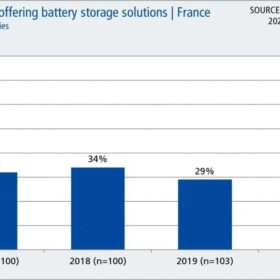
French solar installers ramp up storage offerings
The “Global PV Installer Monitor 2020/2021” reports shows that nearly two-thirds of French PV installers now integrate storage solutions into their product portfolios. EUPD Research said this is a clear sign that rising electricity prices and demand for electric vehicles are creating new business models.
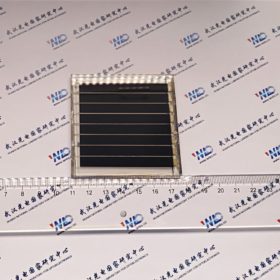
16.63%-efficient perovskite PV module via slot-die coating
Scientists in China have developed a large-area perovskite solar panel by utilizing diphenyl sulfoxide (DPSO) as an electron acceptor. The device was fabricated via slot-die coating, and featured a parallel-interconnection architecture.
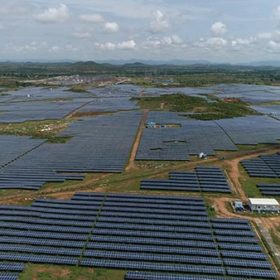
India’s 250 MW solar auction concludes with lowest bid of $0.033/kWh
A unit of Tata Power has secured the rights to develop a 250 MW grid-connected solar project in the Indian state of Maharashtra.
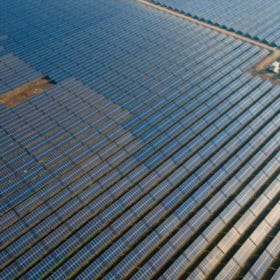
Canadian investor plans 1.3 GW renewable energy hub in South Australia
Amp Energy, a Canadian clean energy investor with a growing Australia portfolio, has unveiled a new 1.3 GW renewables expansion strategy. Its plan includes at least three massive PV projects, two of which could support South Australia’s green hydrogen aims.
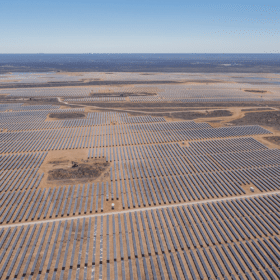
Massive solar-plus-storage plant comes online in the United States
The 420 MW/40 MW storage-plus-storage facility was deployed by the Danish energy company Ørsted on a 3,600-acre site alongside existing oil and gas installations in Texas.
Chinese PV Industry Brief: Xinte seeks to raise $309 million for 100,000-ton polysilicon factory
Furthermore, Luoyang Glass reported first-quarter net profits of RMB136 million (US$21 million) and TBEA Xinjiang New Energy announced the settlement of a dispute over a 99 MW wind farm.
