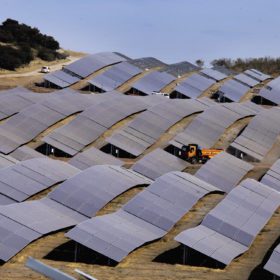
Iberdrola’s 500 MW Núñez de Balboa PV plant reportedly caused Spain blackout
Spanish grid operator Red Eléctrica de España (REE) says a PV project in Badajoz was responsible for Spain’s massive power outage on April 28. Media reports have now revealed that the solar plant is the 500 MW Núñez de Balboa photovoltaic facility, which is owned by Iberdrola.

Spanish grid operator claims power outage originated from solar plant
Beatriz Corredor, president of Spanish grid operator Red Eléctrica de España (REE), said a fault at a PV plant in Badajoz, Spain, triggered a forced frequency oscillation that led to a recent blackout. She said the plant has been “perfectly identified.”

Overvoltage, chain reaction, improper disconnections behind Spain’s blackout
Spain’s Minister for the Ecological Transition, Sara Aagesen, has presented an official report on the April 28 blackout. She also announced 11 measures to strengthen grid stability and prevent future incidents.
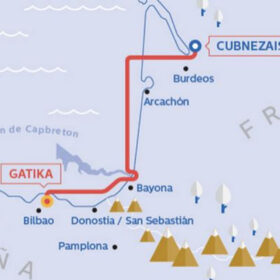
France, Spain raise interconnection link capacity from 2.8 GW to 5 GW
France and Spain have driven up the planned capacity of their Bay of Biscay electricity interconnection from 2.8 GW to 5 GW, with €1.6 billion ($1.8 billion) in financing approved by the European Investment Bank (EIB).
Spain blackout probe stalls amid utility data disputes, voltage issues
The European panel investigating Spain’s April blackout has reported stalled progress due to noncooperation from utilities, hindering efforts to pinpoint causes amid disputes over voltage irregularities and data access.

Spanish government provides further details in blackout update
Spain’s ecological transition minister has confirmed that the problem was not a reserve or coverage issue, nor was it due to the size of the grids. The government is also analyzing whether the fluctuations felt in Europe half an hour before the blackout were related to the incident.

Amelia Hub unveils all-in-one solution for pile-driving and tracker installation
The Spanish company has launched the Hincator, a device that precisely measures key pile parameters, and Amelia Solar, a cloud platform that processes data in real time, to ensure pile-driving and trackers in PV plants are installed correctly and within project tolerances.
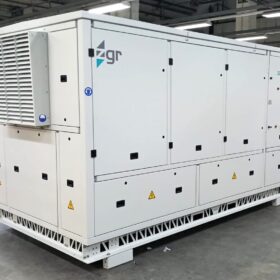
ZGR presents new range of 4500 kW central inverters and PCS at Intersolar
The entire range is prepared to operate under the future 2000 V regulations, allowing them to operate in various international markets, including Europe and Latin America.

Spain’s Smartbox presents 100% autonomous cleaning robot
It comes with two plug-and-play batteries, each with 4.5 hours of battery life, and is capable of cleaning up to 4,000 panels in 10 hours.

Is solar really the root cause of Spain’s massive power outage?
Some media outlets have speculated that Spain’s April 28 blackout may have been caused by a disconnected solar plant, but DNV grid analyst Andrea Mansoldo tells pv magazine that it was likely due to a combination of grid weakness and low-frequency oscillations.
