
German startup installs industrial heat pump producing 139 C steam
German start-up SPH has installed its ThermBooster heat pump at Philip Morris International’s Italian factory, producing high-temperature steam at 139 C. The system boosts energy efficiency, cuts gas use by up to 50%, and recovers 20–30% of water from exhaust.
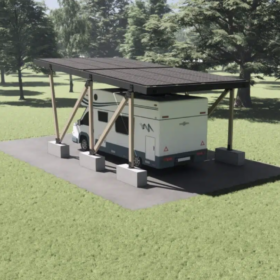
French startup unveils solar canopy for motorhomes
France’s Genelios has developed an 8 kW modular solar canopy for motorhomes, offering manufactured-in-France construction, multiple installation options, and services that include design, monitoring, and maintenance for users across France, Belgium, Switzerland, and Luxembourg.

Fraunhofer ISE achieves 30.6% efficiency for perovskite-silicon tandem based on industry-standard bottom TOPCon cell
Researchers at Fraunhofer ISE have developed a perovskite-silicon tandem solar cell using a TOPCon bottom cell with standard textured front surfaces. Their results show that TOPCon bottom cells can perform comparably to heterojunction cells in tandem devices in terms of shunt resistivity, supporting scalable, cost-effective industrial production.

Agrivoltaics for sorghum, soybean grain
Researchers in the United States found that shading from agrivoltaic systems reduces grain numbers in both sorghum and soybean, but sorghum can partially compensate by increasing grain weight while soybean cannot. The study shows that sorghum and soybean respond differently due to their physiology, offering guidance for crop selection and management to minimize yield penalties in agrivoltaics.

How to use compressed air storage in flooded coal mines
Researchers in China developed a new compressed air energy storage system that uses flooded roadways in abandoned coal mines to store compressed air and heat for nighttime power generation. Simulations show the design can achieve 71.5% thermal efficiency, stable performance, and higher energy density at greater depths, with minimal long-term impact from air leakage.
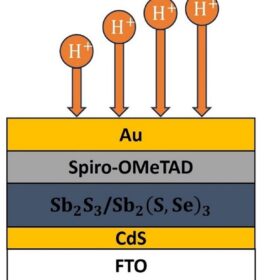
New research shows antimony chalcogenide solar cells are suitable for space use
Researchers in the US tested the degradation of antimony chalcogenide solar cells exposed to proton radiation. The result indicated a robust tolerance and potential for use in space.

Panasonic glass-based perovskite solar panels tested in office windows
The Japanese electronics manufacturer is testing its glass-based perovskite solar PV technology in office windows made by YKK AP, a construction and building materials company.

Huawei unveils FusionSolar 9.0 platform with AI, grid-forming tech
Huawei’s FusionSolar 9.0 is a new integrated solar-plus-storage platform featuring smart inverters, AI-driven management, and grid-forming capabilities to turn solar plants into active grid-support assets. It boosts efficiency, reduces costs, and enhances stability in weak grids with high renewable penetration, according to the company.
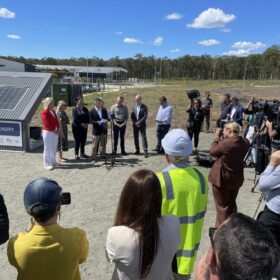
Sunman to build 500 MW solar panel manufacturing plant in Australia
Chinese manufacturer Sunman is to build a 500 MW per annum solar module production facility in the New South Wales Hunter Valley after securing funding support from both the state and federal governments.

Optimal solar-plus-storage sizing for heavy industry operation
Australian researchers developed a high-resolution energy modeling framework to assess how PV and batteries can supply 24/7 electricity to heavy industries, considering cost, grid interaction, and load flexibility. They found that, while technology cost reductions help, smart grid integration and flexible industrial operations are far more effective in lowering electricity costs and enabling 100% renewable energy use.
