
New solar window tech from Australian startup
Australia’s ClearVue wants to push ahead with the development of its transparent solar glass technology. Construction is now beginning on a commercial-scale trial project.
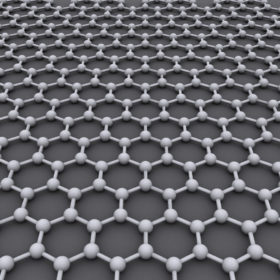
Investors bet $27.5 million on Nanotech Energy’s graphene battery breakthrough
Nanotech Energy plans to release a non-flammable, environmentally friendly lithium battery that can charge “18 times faster than anything that is currently available on the market.” And it aims to do it within the next year.

Long-term assessment of PV panel degradation under hot, humid tropical climates
A Dutch-Hungarian research team has measured, for 12 years, the degradation rates of PV modules installed in an off-grid system located in Ghana. It found that the panels had an average annual decline in power yield of 3.19%.

Agrivoltaic beekeeping project in Spain
Endesa plans to set up beekeeping projects at two of its PV plants. The pilot initiative will include the cultivation of 3 hectares of plants that will be pollinated by bees.
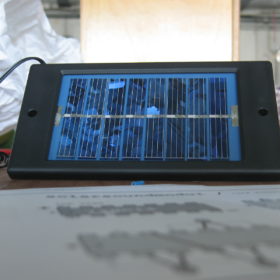
AI model for accurate prediction of organic PV efficiency
Over the last few months, Nastaran Meftahi has been spending her time in pandemic lockdown developing a machine-learning model to predict the future of next-generation organic solar cells.

Fraunhofer IMWS aims to make it possible to predict reliability and service life of inverters and batteries
The German research institute wants to develop an efficient and reliable methodology, which could contribute to considerable cost reductions in photovoltaic generation – both for manufacturers and operators.
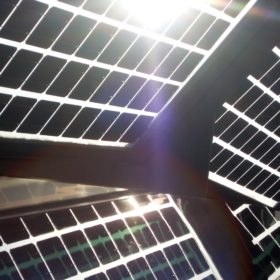
Rectangular aluminum fins for PV module cooling
Scientists in Pakistan have proposed a new passive cooling technique which they claim can improve a module’s open-circuit voltage by up to 12.97% and its efficiency by up to 2.08%.
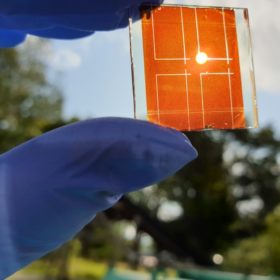
New tech to apply perovskite thin-film layers to conventional solar panels
According to its creator, Swedish start-up Evolar, the new technology can be applied to existing production lines for crystalline silicon modules and increase a product’s efficiency by around 5%.
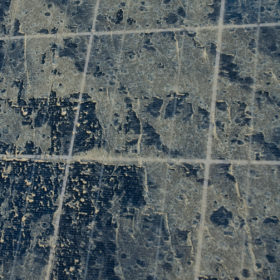
New panel cleaning tech based on nano-coating and mechanical vibration
Researchers in Egypt have tested a new solar module cleaning technique for solar arrays in arid regions. They claim that the combination of nano-coatings with vibration mechanisms on the backs of modules can reduce manual cleaning requirements.
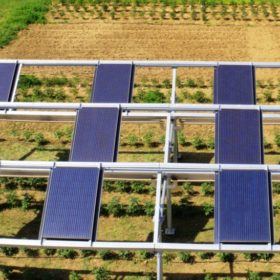
French alliance to build intelligent shade systems for agrivoltaics
French companies Ombrea and RES are partnering on the development of special PV shade systems for agrivoltaic projects. The devices will be equipped with artificial intelligence technologies to make them react to unfavorable weather conditions.
