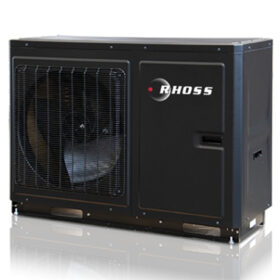
Rhoss unveils propane air-to-water heat pump for residential, small commercial applications
The Italian manufacturer has launched a compact range of propane air-to-water heat pumps for heating, cooling, and domestic hot water in residential and light commercial applications, offering up to 15.5 kW heating capacity, a seasonal coefficient of performance of up to 5.18, and water temperatures up to 80 C.
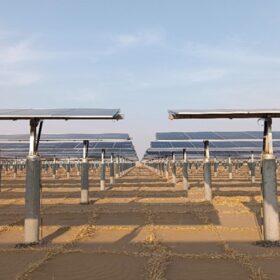
How solar farms shape local climate and vegetation in arid regions
Researchers in China found that PV plants in arid regions create a measurable cool island effect that varies strongly with season, location, and plant design, influencing surrounding vegetation in complex and spatially uneven ways. They showed that cooling intensity and distance differ widely across sites, are driven mainly by plant morphology,
Reduced graphene oxide boosts stability in perovskite solar modules
Indian scientists have fabricated perovskite mini-modules with reduced graphene oxide interface engineering, achieving 16.6% efficiency and over 1,300 hours of stable operation. The graphene oxide layer improves film quality, reduces defects, enhances charge transport, and enables scalable fabrication, offering a promising route toward efficient and durable perovskite solar modules.

Dismantled 28-year-old PV system reveals wasps nest in junction box
Researchers in Austria discovered a wasp nest inside the junction box of a 1998 rooftop PV module, illustrating how insects can exploit even sealed electrical components. The affected module showed significant degradation and partial failure, though overall results confirmed the surprising durability of older PV module designs.

Cyber threats for PV: What are man-in-the-middle attacks and how do they work
Man-in-the-middle attacks are a serious threat to networked PV systems, allowing attackers to intercept, modify, or disrupt communications, potentially causing operational failures, physical damage, financial losses, and safety hazards. Effective defense requires a layered approach combining encryption, strong authentication, network segmentation, firewalls, IDS, and continuous monitoring to detect, prevent, and limit the impact of such attacks.

Turkish manufacturer presents photovoltaic water heater
Adana-based WHS introduced a PV-powered water heating system that operates without an inverter, using 1.6 kW of direct DC solar input with integrated MPPT. The system supports hybrid operation with a 2 kW AC backup, runs at extra-low voltage of less than 50 V, delivers around 3 kWh/day of thermal energy, and heats water to 65–85 C for residential and small commercial use.

Solar PV, geothermal hybrid systems are more than niche solutions
Solar energy, driven by excellent resource conditions and rapidly improving economic attractiveness, is expected to emerge as a bulk energy supplier in future energy systems. The self-limiting effects of solar power can be circumvented through solar-hybrid solutions, such as PV-geothermal hybrid configurations.
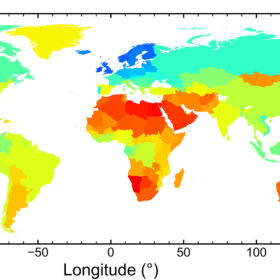
Solar PV Capex could fall to $192/kW by 2050
A review of 60 renewable energy studies finds that by 2050, solar PV and wind could supply 80–100% of electricity, but overly conservative Capex assumptions and simplified PV modeling often underestimate deployment potential. While future PV costs depend on supply chains and geopolitical risks, historical experience suggests medium-term risks are manageable, and material constraints are being resolved.
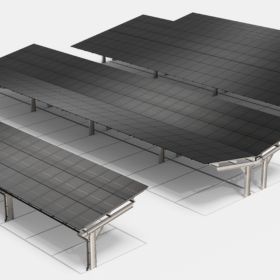
Solarport launches modular PV carport series
Solarport has launched the modular PowerPark PRO PV carport series, designed to meet UK/EU parking standards and adapt to various site layouts with multiple configurations and orientations.
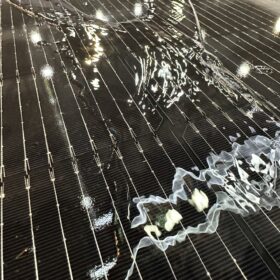
Internet-of-Things could bring solar module water cooling closer to commercial viability
A Czech team developed an IoT system using MQTT to autonomously cool PV panels, boosting daily energy yield by 7.38% with a positive net energy balance.
