
After a suppressed first quarter, the US solar market is buoyed by tariff suspension
The Wood Mackenzie/SEIA US Solar Market Insight Q1 report finds that the two-year suspension on new solar tariffs is just a start. Passage of further clean energy legislation could boost US solar installations 66% in the next decade.

US government announces $3.1 billion of funding for battery manufacturing, processing, recycling
$3.1 billion is available to increase production of American-made batteries, with a separate $60 million to support second-life applications for used EV batteries, along with development of processes for recycling materials back into the battery supply chain.

US government to move forward with PV anti-circumvention investigation
The announcement of a new anti-circumvention investigation brings the US solar industry closer to what has been described as a worst-case scenario for companies that account for 80% of the country’s solar cell imports, with no domestic manufacturing capacity to alleviate the pressure.
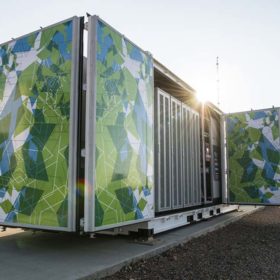
Developing better behind-the-meter energy storage
NREL researchers work on developing high energy density cells to advance stationary storage.
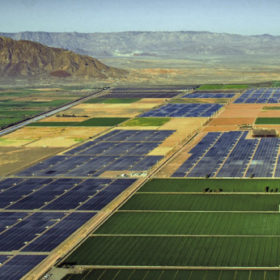
US legislation introduced to build renewable energy ‘superhighway’
Sen. Ed Markey’s Charge Act requires forward-looking transmission planning by utilities to lower prices and improve reliability. Among other sweeping changes, the bill requires hourly operational and greenhouse gas emissions reporting in a timely manner.
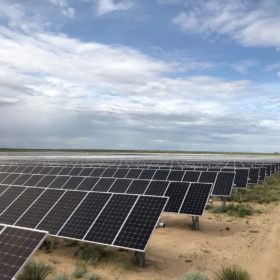
Newer, larger PV plants perform better, while older plants pick up steam with repowering
An American government lab sees utility-scale solar fleets degrading faster than projected at 1.2% per year, while newer and larger plants are degrading at just 0.7% per year. Older plants appear to be getting repowered in year seven, resulting in lasting performance increases.
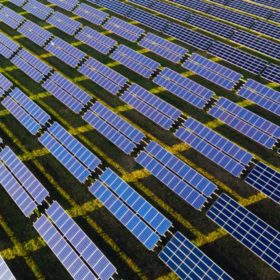
US coal company launches venture to develop 3.3GW of PV
US coal company Peabody Energy has launched a joint venture with Riverstone Credit Partners and Summit Partners Credit Advisors to develop more than 3.3GW of solar and 1.6GW of battery storage capacity over the next five years.
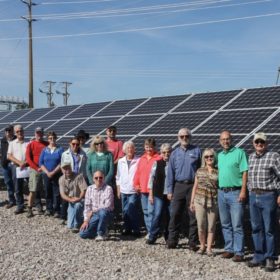
US targets 5 million community solar households by 2025
The US National Community Solar Partnership, a Department of Energy program, has released a roadmap to reach 5 million community solar households by 2025.
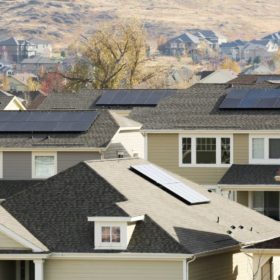
US added 5.4GW of small-scale PV last year
Some northern states added as much small-scale PV per capita as the top states in the Southwest, taking advantage of solar irradiance in northern states that’s about 70% as high as that in the desert Southwest.

Los Angeles soon be home to the largest US green hydrogen infrastructure system
Southern California Gas Company is submitting an application to build a 10 to 20GW electrolyzer and 25 to 35GW of new and curtailed wind and solar, along with 2GW of energy storage, to deliver green hydrogen to the Los Angeles Basin.
