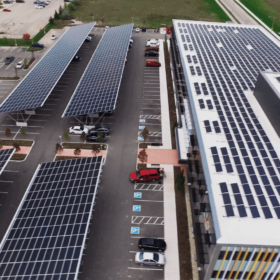
U.S. decarbonization goals hinge on scaling up heterojunction solar cell tech
HJT technology could fill an innovation gap in the residential and commercial rooftop PV market, and boost U.S. solar leadership through domestic manufacturing of cells and modules.
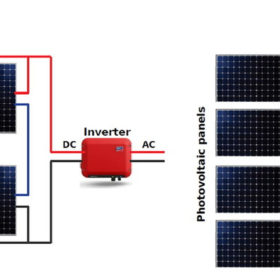
Micro-inverters vs. string/central inverters
A French research group has compared the performance ratio of 100 PV systems relying on micro-inverters with that of 100 installations relying on string/central inverters. It found the performance ratio is around 79% for both system typologies and that arrays with micro-inverters are more sensitive to environmental factors.

Canadian mining company acquires 10 vanadium sites in Morocco
Canada-based Elcora said the transaction will enhance its mining operations and energy storage business.

The Good, the Bad and the Ugly: defects in perovskite solar cells
Scientists in the UK delved deep into the structure of a perovskite solar cell, looking to understand the complex relationship between the materials that make up the perovskite layer, and the role of different defects in both limiting and improving performance. The findings could allow for new perovskite materials that are specially structured to maximize PV performance.

‘Italy needs own supply chain to navigate raw materials crisis’
Paolo Rocco Viscontini, president of trade association Italia Solare, has spoken to pv magazine about the challenge high system prices pose to Italian solar and discussed the nation’s ‘super bonus’ tax deduction, which remains the main market driver for small scale arrays.
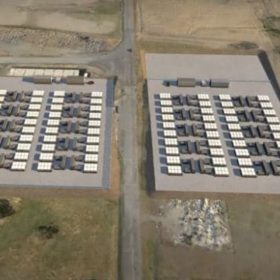
Australia’s AGL secures planning approval for proposed Loy Yang big battery
Australia’s largest energy gen-tailer, AGL, says it has received approval for a 200 MW/800 MWh grid scale battery to be developed at the site of its coal-fired Loy Yang power station in Victoria’s Latrobe Valley.
Central Electronics Limited tenders 95 MW of solar sites in Indian state of Maharashtra
The successful contractor will install the arrays in blocks of 2-10 MW and will carry out all stages of installation, from site surveys through to 12 years’ operation and maintenance.

Color-tunable transparent silicon solar cell with 7.38% efficiency
Designed for BIPV applications by scientists in Korea, the solar cell is based on a 100μm-thick n-type silicon wafer and has a bending radius of 3-6mm.

Phase-change material tech to store thermal energy, solar electricity in buildings
NREL scientists have unveiled a storage system based on a phase-change material that can store both thermal energy and electricity in a single device. According to the researchers, the new technology may be used to store excess electricity produced by on-site solar or wind operations in large scale buildings.

The weekend read: Cloud looms over PV’s silver lining
Should heterojunction solar technologies be temporarily shelved? Could copper plating replace screen-printed silver conductive surfaces in cells? Why are tandem cells a likely successor to PERC? Brett Hallam recently sat down with Natalie Filatoff in Sydney to explain the findings of a new study by UNSW that sought to answer these controversial questions.
