
Malaysia launches scheme enabling consumers to buy renewable energy
Through the Green Electricity Tariff (GET) program, the government will offer 4,500 GWh of power to residential and industrial customers each year. These will be charged an additional MYE0.037 ($0.087) for each kWh of renewable energy purchased.
South Korea’s largest floating PV plant now online
The 41 MW facility was built by Korean developer Scotra with solar modules provided by South Korea-based manufacturer Hanwha Q-Cells. It was deployed on a water reservoir at the Hapcheon dam, in the South Gyeongsang province.
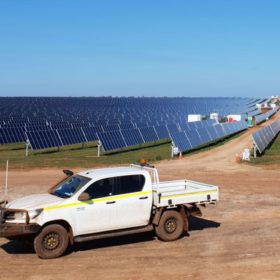
Renewables to drive down prices as fossil-fuel generators exit Australian electricity market
Ongoing growth in both renewable generation capacity, including rooftop solar, large-scale wind and solar, and dispatchable power in the form of big batteries is expected to drive down household power bills across the National Electricity Market in the coming years despite the impending closure of several of Australia’s ageing fossil-fuel fired power stations.
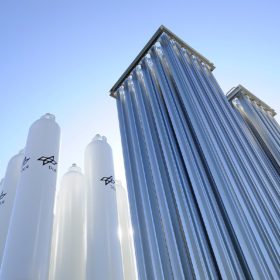
Utilities and financial investors are investing in renewables, especially hydrogen, like never before
A new Ernst & Young power and utilities overview report shows that utilities and other deep-pocketed investors are putting financial support behind their environmental, social and governance initiatives.
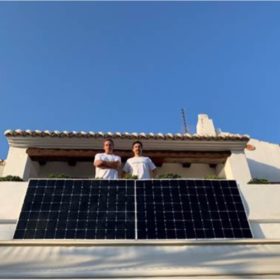
UPDATE: Spanish start-up offers flexible kit for balcony solar power generation
The kit consists of one or two modules, a microinverter, and a five-meter cable. Thanks to its plug-in technology, it can be connected to any electrical outlet and immediately begin generating electricity.

Belgian network to host 25 MW/100 MWh battery for grid services
The energy storage system, which is set to be up and running in around a year’s time, will be supplied by Finnish company Wärtsilä and will provide services including reserve power and frequency control response.

Developers building solar park along French highway
The five-hectare project is part of the Vinci Group’s plan to develop unused areas close to the motorways operated by its unit Vinci Autoroute.
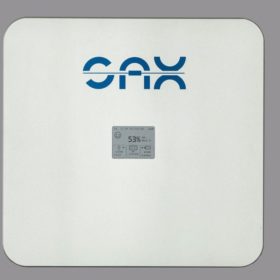
Germany will continue to dominate European home battery market – no matter who is in government
Industry association SolarPower Europe expects little change in the line-up of Europe’s biggest residential battery markets in four years’ time, with a rush of retrofits as turn-of-the-century solar feed-in tariffs begin to expire, set to keep Germany way ahead of the pack.
Romania allocates $63.7 million for solar rebates in 2022
The scheme provides rebates for installations larger than 3 kW in size provided that the grant does not exceed RON20,000 for conventional projects and RON25,000 for projects in isolated areas.
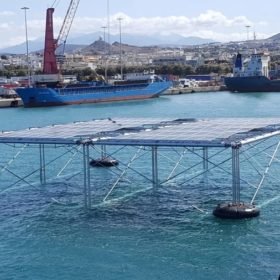
Pilot floating platform for offshore hybrid wind-solar-wave projects
Developed by German company Sinn Power, the floating platform currently hosts solar modules totaling 80 kW and may also embed small wind turbines and wave energy converters.
