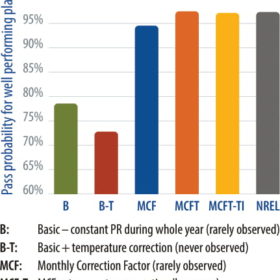
We all trust the PV performance ratio test – but should we?
The performance ratio test is at the core of the handover from EPC to owner. Yet sometimes, even when best practice is applied – and without particularly demanding guaranteed values to be achieved – these tests fail good projects. This can lead to costly delays and wasted effort spent trying to find issues that might not exist. Everoze Partner Dario Brivio reviews the likelihood of this happening and considers ways to increase confidence in the precision of such tests, based on recent independent analysis of real-world projects.
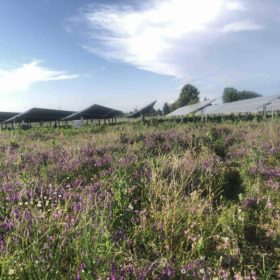
Pollinator-focused solar parks
Researchers in the US ascertained that the partial shading provided by solar parks creates a microclimate that favors the abundant growth of more varied flowers and pollinators. They also found that partial shading increases bloom abundance by delaying bloom timing, increasing forage for pollinators during the hot and dry late season.
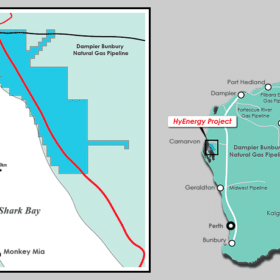
Australian green hydrogen project grows from 1 GW to 8 GW, following commitment from Total Eren
Province Resources has signed a memorandum of understanding with French renewable energy developer Total Eren, which could see the two companies have equal shares in Province’s HyEnergy Zero Carbon Hydrogen project proposed in northwest Western Australia.
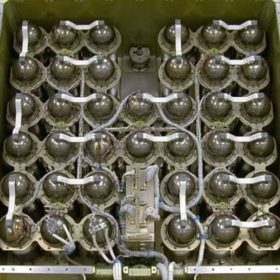
US start-up secures distribution agreement for nickel-hydrogen battery technology
EnerVenue signed its first major distribution agreement with Hong Kong’s Towngas. The deal will pilot the company’s nickel-hydrogen battery technology and serve as an audition for future deals to come.

ECJ indicates EU member states free to revise signed feed-in tariff contracts
The court has agreed with advocate-general Henrik Saugmandsgaard Øe that Italy’s move, in 2014, to reduce solar incentive payments contained in signed agreements held by developers does not breach EU law.
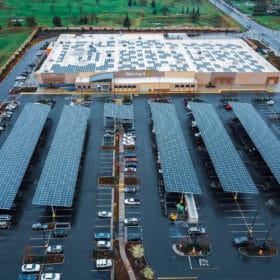
Walmart adds 6.5 MW of rooftop and canopy parking solar to California stores
The $10 million portfolio was developed by Sol Customer Solutions and will deliver energy to seven stores across the state.
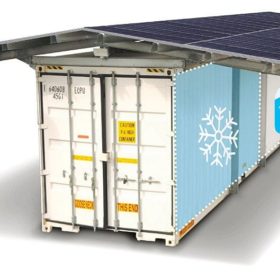
Cold room powered 100% by solar
The Cryosolar solution consists of a 20-foot or 40-foot container equipped with a plug-and-play PV system installed on the roof. It has 180 mm thick insulation and 10 to 35 cubic metres of storage with shelves.
Model agreement to make solar and wind share same connection point in the Netherlands
The model agreement was outlined by Dutch consultancy Ventolines B.V. and follows the introduction of new provisions for the sharing of the same connection point issued by the country’s government last year.

Adani wins 150 MW Indian solar tender with bid of $0.03/kWh
The PV plant—to be set up in the state of Gujarat for a private utility—will supply power for INR2.22/kWh for 25 years.
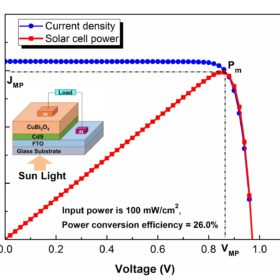
Heterojunction design for 26%-efficient copper bismuth oxide thin-film solar cell
Researchers in Bangladesh have simulated a solar cell based on a copper bismuth oxide material, used as an absorber, with n-type cadmium sulfide (CdS) utilized as a buffer layer. In the experiment, the device achieved an efficiency of 26.0%, an open-circuit voltage of 0.97 V, a short-circuit current density of 31.61 milliampere per square centimeter, and a fill factor of 84.58%.
