Cooling down solar modules by increasing space between panel rows

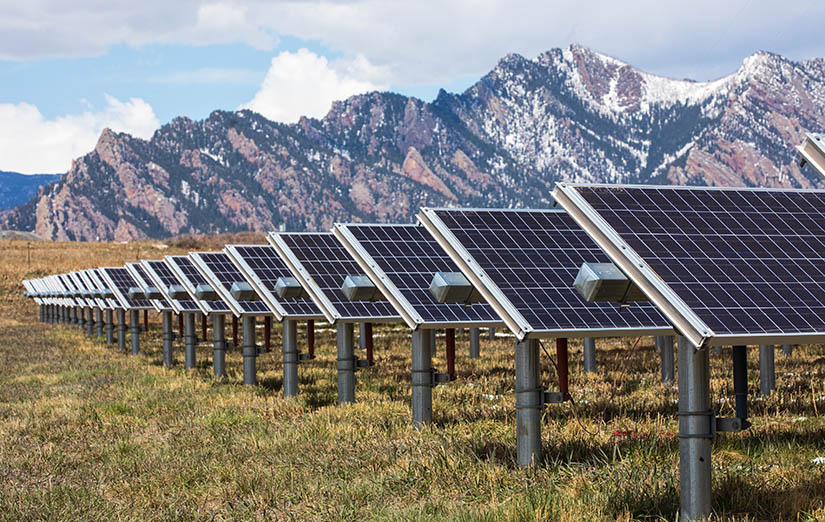
A research group led by the US Department of Energy’s National Renewable Energy Laboratory (NREL) has proposed a new approach to utilize connective heat transfer for solar module cooling in large-scale solar power plants.
Their modeling considers factors such as row spacing, panel height, and tilt angle. It also uses a length scale input to characterize the space through which air moves around or through the solar modules. In the standard models, by contrast, the length often used is a ratio of module dimensions, which ignores PV plant configuration.
“The convective heat transfer curve was generated through computational flow simulations and wind tunnel experiments that allowed for convective heat transfer to be described for a lacunarity length scale value that describes the spacing of the entire PV array through a single length unit,” the scientists said, claiming that using the lacunarity length scale leads to 1.5% more accurate power production.
Their techno-economic analysis considered 1 MW south-facing PV systems located in Phoenix, Arizona, with a fixed tilt angle of 30 degrees over different row spacings, or ground coverage ratio (GCR). The annual land lease cost was assumed at $0.054/m2. The row spacing of the PV plants was varied from two to 11 meters, corresponding to GCR values of 0.73 to 0.08.
“Increasing spacing could enable more varieties of crops and more types of agricultural equipment to be utilized in agrivoltaic systems,” said Jordan Macknick, who leads a different NREL research project focused on agrivoltaics. “That could potentially make these spaced-out solar systems more cost-effective and compatible with larger-scale agriculture.”
Through the modeling, the group ascertained that the optimal levelized cost of energy (LCOE) point was $0.29/kWh, with row spacing varying between 4.83 and 7.34 meters. With two-meter spacing, the LCOE was $0.33/kWh, and with 11 meters it was $0.36/kWh.
The group found that the greatest LCOE improvements were registered in climates with low average annual ambient temperatures and moderate to high average annual wind speeds across the US. They presented the modeling in the study “Technoeconomic Analysis of Changing PV Array Convective Cooling Through Changing Array Spacing,” recently published in the IEEE Journal of Photovoltaics.
Other recent proposals for using convective solar module cooling include packing PV panels in close proximity, and taking wind direction and module inclination into account.
This content is protected by copyright and may not be reused. If you want to cooperate with us and would like to reuse some of our content, please contact: [email protected].

Please login to comment

[…] A US research team claims to have demonstrated that increasing the spacing of solar panels between rows improves PV system efficiency and economics by allowing airflow to cool down the modules. The method could improve a project’s LCOE by as much as 2.15% in certain climates…Read More […]

And don’t forget to cover them up during hailstorms.
[…] often used is the ratio of unit sizes, which ignores the PV plant configuration, according to PV . magazine from his […]
[…] customers. Solar water heating systems consist of a number of components, including a water tank, a solar panel, a water heating unit, and a control panel. All of these components must be working properly in […]
[…] De pv magazine Global […]
[…] From pv magazine global […]
[…] From pv magazine global […]
So how much are solar panels adding to the global warming crisis?! I’d think that with them increasing the air above them by 9° Celsius it seems more of a detriment!