
India hits 70 GW solar milestone
India’s cumulative solar capacity reached 70.10 GW on June 30. The states of Rajasthan, Gujarat, and Karnataka accounted for more than 50% of the total.
The Hydrogen Stream: Germany to use hydrogen ‘in all sectors’
The German authorities have announced plans to double domestic electrolysis capacity to 10 GW by 2030, BloombergNEF has reported that green hydrogen became competitive with gray hydrogen earlier than expected, and Chinese researchers have presented new research on microbial hydrogen production.
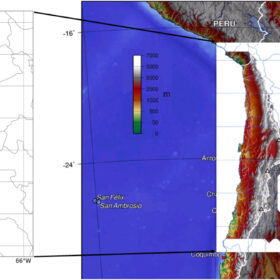
Assessing the future PV potential of the world’s sunniest region
Researchers in Spain have investigated how climate change may possibly impact solar power generation in the world’s region with the highest solar radiation levels – the Atacama desert in northern Chile. They found that, although global warming has the potential to impact solar power generation in the Atacama region, the desert will still retain exceptional conditions for solar power production.

East African Power to build 266 MW of solar under PPAs in Congo
East African Power says it will build two 133 MW solar projects. The installations have 20-year power purchase agreements (PPAs) with the national utility, Société Nationale de l’Electricité (SNEL).
RCT Solutions secures order for 10 GW solar module factory in Canada
RCT Solutions says it will provide its module production equipment for CAD 3 billion ($2.26 billion) in a 10 GW solar module factory in Manitoba, Canada. The Manitoba provincial government said in a statement that the facility will be fully integrated.
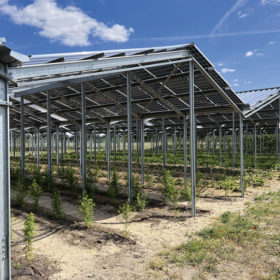
Croatia adopts legal framework for agrivoltaics
The Croatian government has adopted bylaws to the Spatial Planning Act that define agrivoltaic installations and the areas in which they can be deployed, in order to facilitate future deployment.
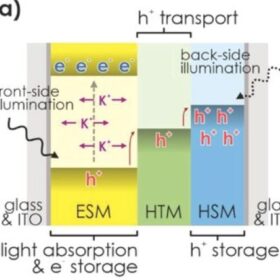
Solar batteries with simultaneous light absorption, storage
Scientists at the Max Planck Institute for Solid State Research have developed a bifunctional solar battery device that enables simultaneous light charging, charge storing, and electric discharging. The device relies on a bifunctional carbon nitride photoanode to harvest sunlight and store its energy via trapped electrons.

Pressure brings sweltering sun and soaking rain: July extremes in America
In a new weekly update for pv magazine, Solcast, a DNV company, presents the solar irradiance data it collected for North America this month. July’s high pressure in the southwest and trough in the northeast dramatically influenced the region’s solar energy production. Persistent high-pressure systems in the southwest led to frequent clear skies and warm air masses, driving up solar irradiance and enhancing potential solar power generation.
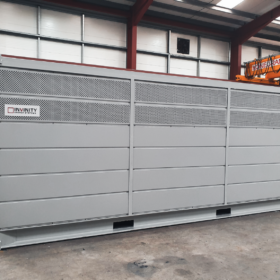
Horizon focusing on vanadium flow batteries for energy storage
Horizon Power, Western Australia’s regional power supplier, has revealed plans to deploy a 78 kW/220 kWh vanadium flow battery.
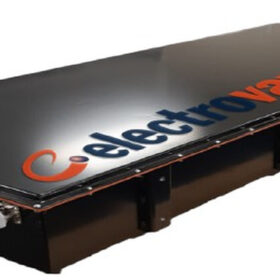
Electrovaya unveils battery tech for high voltage applications, stationary energy storage
The Canadian battery manufacturer offers the product in two versions with a nominal energy of 35 kWh and 70 kWh, respectively. It claims a projected 25-year lifetime for one-cycle per day applications.
