




From pv magazine USA
The Global Electronics Council (GEC) has unveiled the “Criteria for the Assessment of Ultra-Low Carbon Modules.” This set of criteria aims to “establish a framework, standardized methodology, and performance objectives to incentivize manufacturers and suppliers to design and manufacture low embodied carbon photovoltaic (PV) modules.”
The GEC developed two levels of emissions standards: low carbon and ultra-low carbon (ULCS). To meet the low carbon standard, a solar module, including its frame, must have an embodied carbon footprint equal to or less than 630 kg CO2e/kWp. To meet the ULCS standard, a module’s footprint must be at or below 400 kg CO2e/kWp.
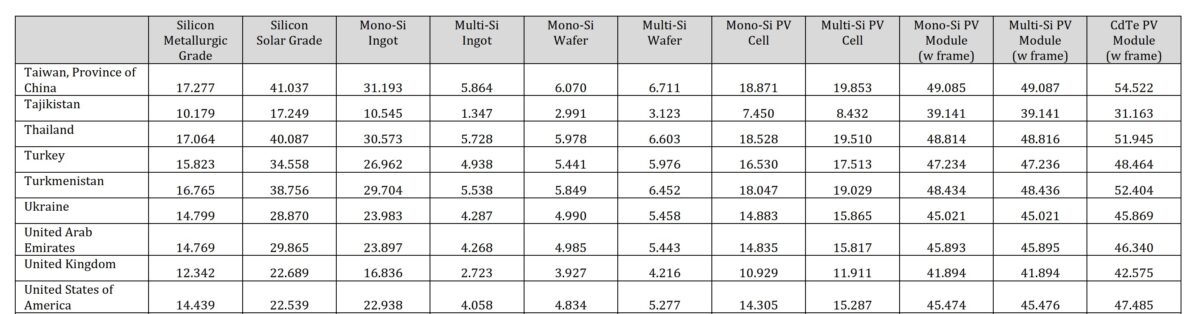
In their analysis, GEC created charts estimating the carbon intensity of power grids in various countries involved in solar panel production. They then calculated a “Global Warming Potential” (GWP) coefficient for each solar panel subcomponent.
This content is protected by copyright and may not be reused. If you want to cooperate with us and would like to reuse some of our content, please contact: editors@pv-magazine.com.


1 comment
By submitting this form you agree to pv magazine using your data for the purposes of publishing your comment.
Your personal data will only be disclosed or otherwise transmitted to third parties for the purposes of spam filtering or if this is necessary for technical maintenance of the website. Any other transfer to third parties will not take place unless this is justified on the basis of applicable data protection regulations or if pv magazine is legally obliged to do so.
You may revoke this consent at any time with effect for the future, in which case your personal data will be deleted immediately. Otherwise, your data will be deleted if pv magazine has processed your request or the purpose of data storage is fulfilled.
Further information on data privacy can be found in our Data Protection Policy.