
How much polysilicon is enough
TU Delft researchers have proposed a new approach for solar cell manufacturing that implies gauging wafer thickness depending on the regions where the cells and modules will be deployed. They also suggested to adopt test conditions that are representative of the outdoor working condition of solar cells in an alternative to standard testing conditions.
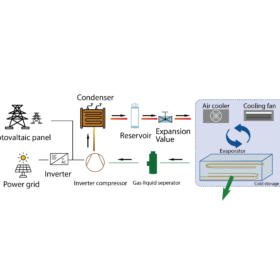
Photovoltaics for cold storage
Researchers in China have developed a photovoltaic cold storage system that is reportedly able to improve refrigeration capacity and ice storage rate. The system is said to ensure a stable cooling system operation for the refrigeration needs of agricultural products.

Australian residential buildings hold 48.5 GW of untapped PV potential
Australia has firmly established its status as a global leader in residential solar deployment, with 35% of all homes already equipped with rooftop systems. However, new figures from the University of New South Wales (UNSW) reveal that there are almost 50 GW of “untapped PV potential” on residential buildings across the country.
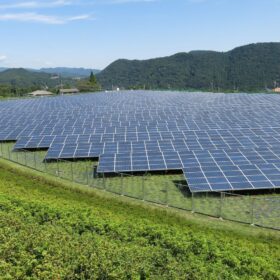
US legal experts dispel 14 false claims about solar, wind, electric vehicles
Columbia Law School has collected and rebutted 33 false claims against clean energy technology as part of its ongoing research on climate change.
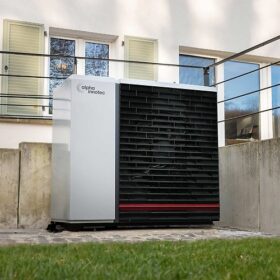
Alpha Innotec launches new residential heat pumps
The German manufacturer said the new air-to-water systems are part of its Hybrox series. Their coefficient of performance is between 4.3 and 5.3 and their size ranges from 11 kW to 16 kW.
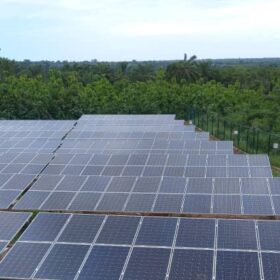
Engie connects solar mini-grid in Benin
The mini-grid, expected to connect over 1,500 residents to electricity, is part of the company’s wider plans to install over 20 mini-grids in Benin, which will serve more than 30,000 people across 20 rural localities collectively, through a total 1.2 MW capacity.
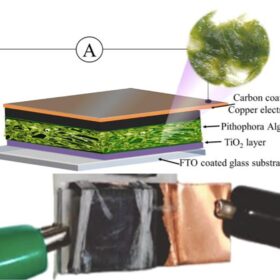
Indian researchers develop solar cell from living algae
The researcher team, from Amrita Vishwa Vidyapeetham university in Coimbatore, India, sandwiched macroalgae between a carbon-coated copper electrode and a titanium oxide-coated fluorine-doped tin oxide electrode. The 1 cm2 device exhibited a 1.25 mA photocurrent and 0.5 V photovoltage under UV light.
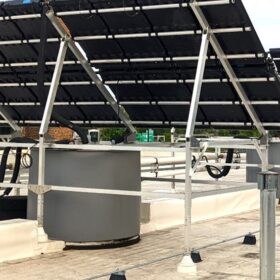
A new twist on thermal storage
Power Panel offers a PV and thermal storage solution that combines simple, safe and easy to manage hot water with advanced thermoplastic technology and architecture.
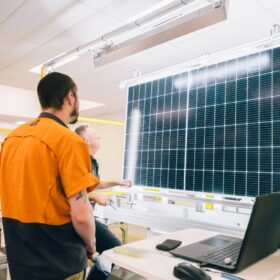
Australian solar manufacturing through the looking glass
The Silicon to Solar report, partly funded by the Australian Renewable Energy Agency, outlines ways to restore solar manufacturing to the nation with a little help from the country’s major trading partner – China.
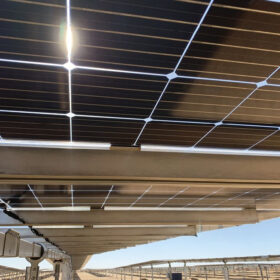
Egyptian solar set to expand beyond the massive 1.8 GW Benban PV project
In this edition of the Weekend Read, we turn to Egypt. The gigawatt-scale Benban project showcases the North African country’s solar potential, and premium prices for gas exports make the case for a more diverse energy mix. A nation with grand renewables targets – but slow installation rates – may finally be weaning itself off fossil fuel resources.
