




From pv magazine USA
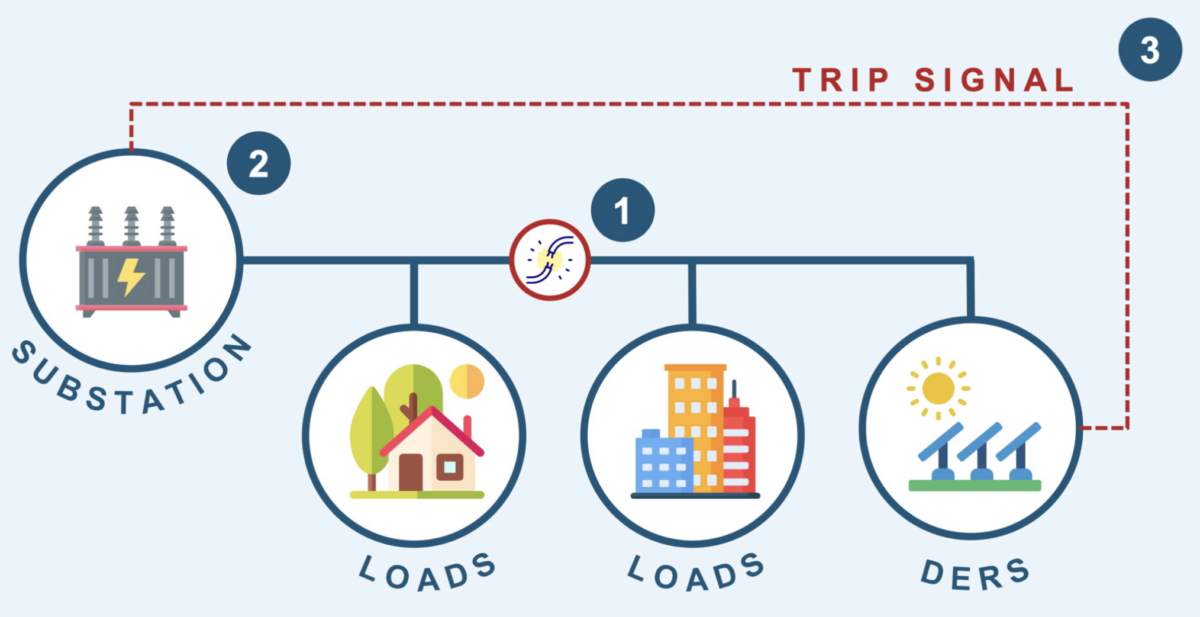
For a community solar project sized at several megawatts, a utility requirement to fund an emergency shutoff technology known as direct transfer trip (DTT), designed to take the project offline in the event of a distribution circuit fault, is “often prohibitively expensive,” said the CCSA, and “many solar project developers have had to withdraw projects as a result.”
While a solar project sending energy into a distribution circuit that the utility believes is de-energized – a phenomenon known as unintentional islanding – would present an electrocution risk to line workers, CCSA cited research and utility experience showing that DTT is unnecessary in most situations.
A low-cost solution recommended by CCSA is for regulators to adopt inverter performance standards prescribed by the IEEE 1547-2018 standard, because such inverters disconnect from utility grids within two seconds of the loss of energy from the utility. CCSA made that recommendation and others in a report titled “Direct transfer trip: The interconnection problem you’ve never heard of.”
DTT costs typically include substation equipment upgrades costing $1 million to $2.5 million, and installation of a communication medium costing $200,000 per mile where a fiber-optic line is required, said CCSA.
Solar developers polled by CCSA reported that DTT has been required by utilities in 14 states, and that 100% of certain project portfolios in at least four states were required to pay for DTT equipment.
Requiring use of IEEE 1547-compliant inverters would allow for a higher penetration of distributed energy resources without requiring DTT by default, CCSA said, noting that the utility National Grid, in cases where there is a potential risk of islanding, relies on inverters certified to meet the IEEE standard “coupled with reclose blocking.”
Engineering study
Now the Interstate Renewable Energy Council (IREC) has released an engineering study on DTT and alternative approaches to mitigating islanding risk, titled “Deconstructing direct transfer trip.”
Based on an in-depth engineering analysis of islanding and other utility concerns and how they may be mitigated, the report finds that in some jurisdictions, utility concerns are “leading to unnecessary and costly grid protection schemes such as DTT.”
IREC advises that regulators should disallow requirements for distribution-level DTT for inverter-based distributed resources, and instead encourage utilities to use “cost-effective” grid protection strategies, such as inverter anti-islanding functions, ground fault protection, and extending reclose intervals. The report notes that most new inverters are compliant with the IEEE 1547-2018 standard.
The report makes further recommendations regarding utility screening studies and analyses related to the risk of islanding.
IREC said that its recommendations support “a modern and risk-informed approach” to mitigating unintentional islanding that can “ensure safe grid operations while accelerating the clean energy transition.”
This content is protected by copyright and may not be reused. If you want to cooperate with us and would like to reuse some of our content, please contact: editors@pv-magazine.com.

By submitting this form you agree to pv magazine using your data for the purposes of publishing your comment.
Your personal data will only be disclosed or otherwise transmitted to third parties for the purposes of spam filtering or if this is necessary for technical maintenance of the website. Any other transfer to third parties will not take place unless this is justified on the basis of applicable data protection regulations or if pv magazine is legally obliged to do so.
You may revoke this consent at any time with effect for the future, in which case your personal data will be deleted immediately. Otherwise, your data will be deleted if pv magazine has processed your request or the purpose of data storage is fulfilled.
Further information on data privacy can be found in our Data Protection Policy.