Solar panel cleaning based on rolling film, motors

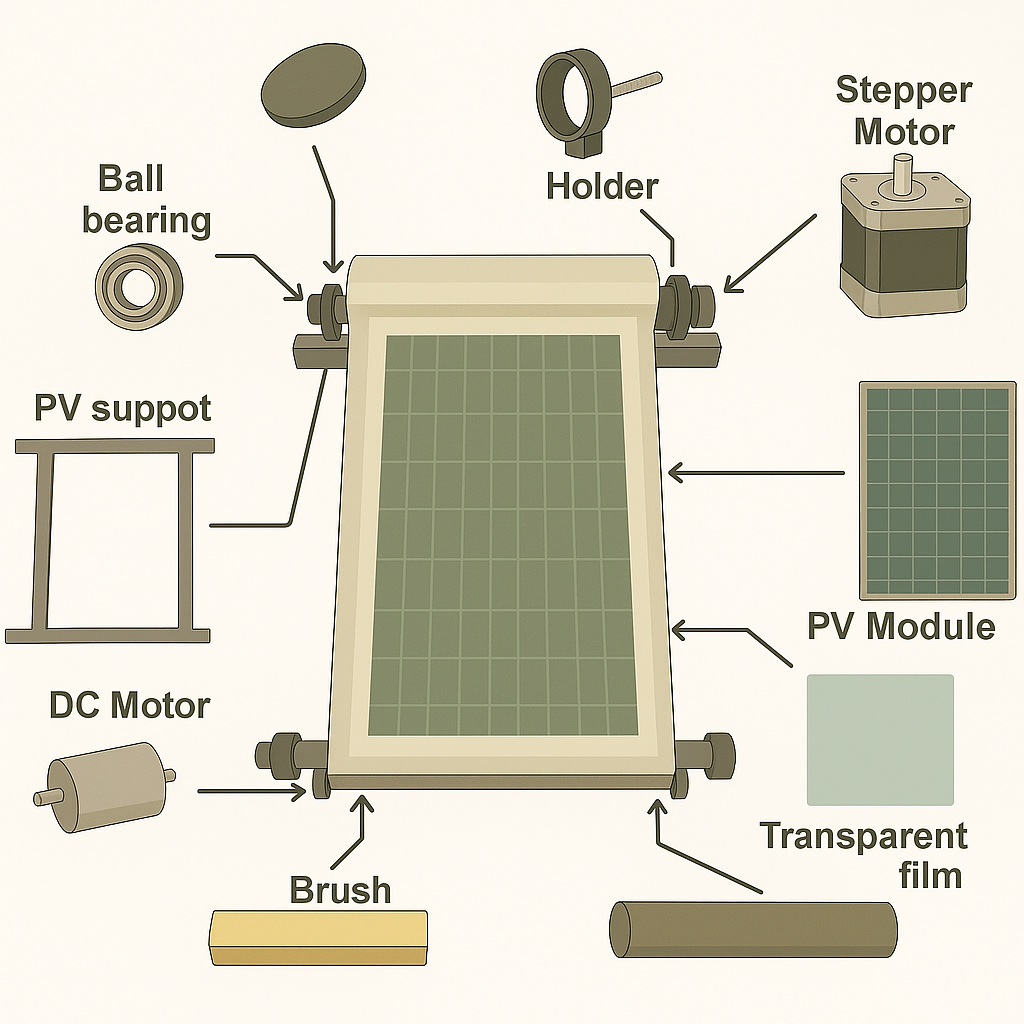
A research group in Morocco has developed a novel solar panel cleaning system that uses transparent rolling film technology to remove dust and bird droppings efficiently.
The system, which has already been patented, represents a step forward in automating solar panel maintenance. The team plans to integrate monitoring systems and artificial intelligence (AI) in future versions to enable predictive cleaning and maintenance.
“Future research directions include applying machine learning to optimize cleaning programs based on environmental conditions, adopting a digital twin approach for predictive maintenance, and integrating performance enhancement features,” the researchers said. “Machine learning algorithms will optimize cleaning schedules, while the digital twin approach will improve predictive maintenance capabilities.”
At the core of the design is a transparent, flexible film that allows more than 95% light transmission and can withstand temperatures of up to 93 C. In the prototype, the film measured 50 × 200 cm, was 2 mm thick, and weighed 1.4 kg. The film moves continuously across the panel surface, driven by two shafts, to remove dust and debris. A spiral brush positioned at the bottom maintains contact with the film, applying consistent pressure during cleaning.
The researchers designed the system to integrate seamlessly with existing PV mounting structures. In their experiments, they tested it on a polycrystalline PV panel measuring 48 cm × 35 cm × 1.7 cm, which delivered a maximum power output of 17.2 V and 1.17 A under standard test conditions. The panel’s open-circuit voltage was 21.2 V, and its short-circuit current was 1.28 A, with an operating temperature range between 40 C and 85 C.
For control, the team used an STM32F429 board, chosen for its balance of processing power, integrated peripherals, and cost-effectiveness in harsh environments. The board autonomously activates the motors for 20 seconds each morning based on humidity and solar radiation levels. The film motor rotates slowly at one turn per second to ensure thorough cleaning, while the brush motor spins faster at six turns per second.
The prototype cost a total of $386 to build, with electrical components accounting for roughly 75% of the total. The current and voltage sensors each cost $70, and a DC-DC converter cost $122.30. The remaining 25% covered mechanical parts, including metal rods and PV panels. The team estimates the electronic components will last 8–12 years in arid operating conditions.
“The proposed transparent rolling film cleaning system was compared with existing PV cleaning technologies to evaluate its advantages and limitations,” the researchers concluded. “The analysis shows that the system is more cost-effective than current methods, particularly in arid climates.”
The system was presented in “A novel solar panel cleaning system for improved efficiency,” published in Unconventional Resources. Researchers from Morocco’s Green Energy Park Research Platform, the Applied Chemistry and Engineering Research Center of Excellence, and the Laboratoire des Sciences Appliquées et Technologies Innovante have participated in the study.

Please login to comment