





Australian shipbuilder Incat Tasmania said work on the world’s largest electric ferry is continuing with one of the 130-meter vessel’s four battery rooms now receiving electrical charge with sea trials to be conducted later this year.
Hobart-headquartered Incat said each of Hull 096’s four battery rooms houses a portion of the 5,016 battery units being installed across the vessel. When complete, the ship will carry a total of about 250 tonnes of batteries with 40 MWh of installed capacity.
Incat Chief Executive Officer Stephen Casey said each of the four battery rooms has been purpose-designed and precision-engineered to house advanced energy storage modules, which will supply clean, reliable power to the vessel’s propulsion and onboard systems.
“To stand inside one of these battery rooms really brings home the scale of what’s being achieved here,” he said. “This vessel represents a step change for the global ferry industry, proof that large-scale, sustainable vessels are not only possible, but practical and commercially viable.”
Hull 096, which has been constructed for South American ferry operator Buquebus, is the largest aluminum ferry yet constructed and the largest electric vehicle of its kind built. When it enters service between Argentina and Uruguay, it will operate entirely on battery-electric power, carrying up to 2,100 passengers and 225 vehicles across the River Plate.
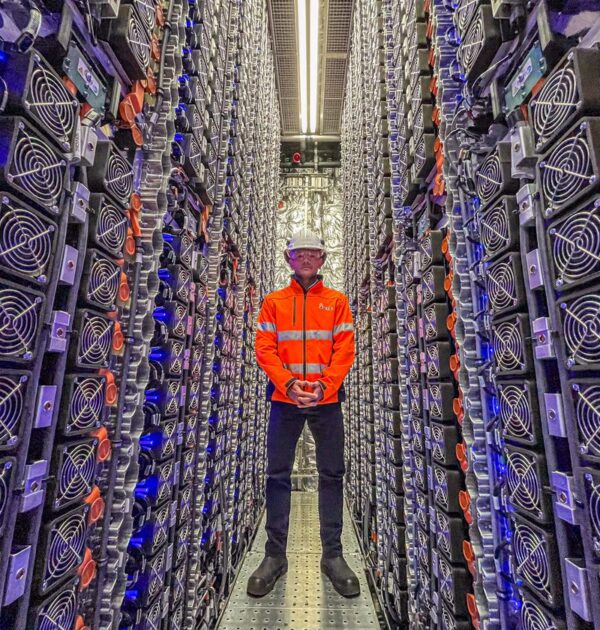
Image: Incat Tasmania
Incat said the ship’s 40 MWh energy storage system, supplied and integrated by technology partners Wartsila and Corvus Energy, is four times larger than any previous maritime installation in the world. The energy storage system is connected to eight electric-powered waterjets.
The batteries on Hull 096 are expected to keep the vessel operating for 90 minutes and chargers will be installed at the ship’s berths in Argentina and Uruguay, with a full charge expected to take 40 minutes.
Casey said the combination of technology deployed in Hull 096 is establishing a new global benchmark for the shipping industry.
“This isn’t just about building a ship, it’s about setting a new course for the future of clean maritime travel,” he said.
This content is protected by copyright and may not be reused. If you want to cooperate with us and would like to reuse some of our content, please contact: editors@pv-magazine.com.



The rubber crossing take about 75 minutes
Then the batteries will be recharged in 40 minutes.
What is it costing to build the charging points at each side? You’re looking at 40MW charging capacity
They’re using a shorter crossing of 50km from Montevideo to BA.
Do you think they haven’t done full costing comparison?
Uruguay has a 98% RE grid.
So the ship can run for 90 minutes on a 40 Megawatt charge. Takes 40 minutes to charge but how much does 40MW of power cost compared to diesel? A diesel electric based power plant would take up far less space and be a fraction of the weight of those 250 tons of batteries. Plus batteries have a very limited service life. What’s it going to cost in maintenance and downtime to replace those batteries?
Do you think they haven’t done full costing comparison?
Uruguay has a 98% RE grid.
Does Uruguay have good diesel resources or do they import liquid FF?
So what happens when a battery pack catches fire out at sea.
If not when
Do you think they haven’t thought of that?
When happens when a diesel tank or ship engine catches fire at sea?
We don’t have any data on fires on electric powered ships but we do have data for ICE and EV cars.
Good maintenance reduces fire risk.
Well, a heavy oil or long ship can also catch fire at sea ?
Interested in future success of these ships 🚢