





The latest figures from energy industry data analyst SunWiz show that Australia registered 1,203 MWh of behind-the-meter battery energy storage capacity through the Small-scale Renewable Energy Scheme (SRES) in December 2025, exceeding 1 GWh for the second consecutive month.
The national market grew by 19% in December 2025, slowing down from its 42% growth the previous month when 1,024 MWh of new capacity was registered. Despite the slowdown, SunWiz Managing Director Warwick Johnston said the market continued to show a consistent upward trend.
“Since the introduction of STCs for batteries, volumes have increased consistently on a month-on-month basis, with no plateau reached to date,” he said.
Not only are more batteries being installed, but they’re also continuing to increase in capacity with the national average system size growing to 32.86 kWh, up from 32.74 kWh in November 2025.
“The key change in the market is the shift towards larger batteries,” Johnston said. “The volume of smaller batteries declined as people sought to take advantage of the substantial subsidy on larger batteries while it remained in place.”
The federal government’s battery subsidy scheme has proven a major success with figures showing that from July 1 to Dec. 31, 2025, Australians installed 184,672 home batteries with a combined 4.27 GWh of storage capacity under the initiative.
The success of the scheme prompted the government to last month usher in changes, including winding back discounts for larger systems amid concerns the budget would be exhausted well ahead of its expected 2030 expiry date.
Under the scheme, eligible households and small businesses have been able to secure a 30% discount on a home battery when installed alongside new or existing rooftop solar. Subsidies were available on batteries with capacities of between 5 kWh and 100 kWh, with the rebate applied to the first 50 kWh.
Under changes announced in December, the first 50 kWh of a system would still be eligible for support, but discounting would not be as generous per kWh for medium- and larger-sized batteries.
From 1 May 2026, systems up to 14 kWh would get the full 30% discount for each kilowatt-hour. Discounting would then taper off for 14- 28 kWh systems, and again for systems above 28 kWh.
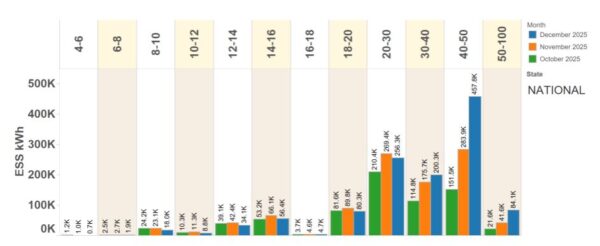
Systems in the 30 kWh to 100 kWh range continued to be the strongest performers in December, led by the 40 kWh to 50 kWh segment, which recorded 61% month-on-month growth. While smaller in overall volume, the 50 kWh to 100 kWh segment more than doubled its volume compared with the previous month.
In contrast, all other segments experienced volume declines, with the residential segment up to 15 kWh showing the largest reduction.
All states recorded growth, ranging from 4% in Western Australia to 62% in the Northern Territory. The remaining states posted double-digit growth between 14% and 24%.
This content is protected by copyright and may not be reused. If you want to cooperate with us and would like to reuse some of our content, please contact: editors@pv-magazine.com.


By submitting this form you agree to pv magazine using your data for the purposes of publishing your comment.
Your personal data will only be disclosed or otherwise transmitted to third parties for the purposes of spam filtering or if this is necessary for technical maintenance of the website. Any other transfer to third parties will not take place unless this is justified on the basis of applicable data protection regulations or if pv magazine is legally obliged to do so.
You may revoke this consent at any time with effect for the future, in which case your personal data will be deleted immediately. Otherwise, your data will be deleted if pv magazine has processed your request or the purpose of data storage is fulfilled.
Further information on data privacy can be found in our Data Protection Policy.