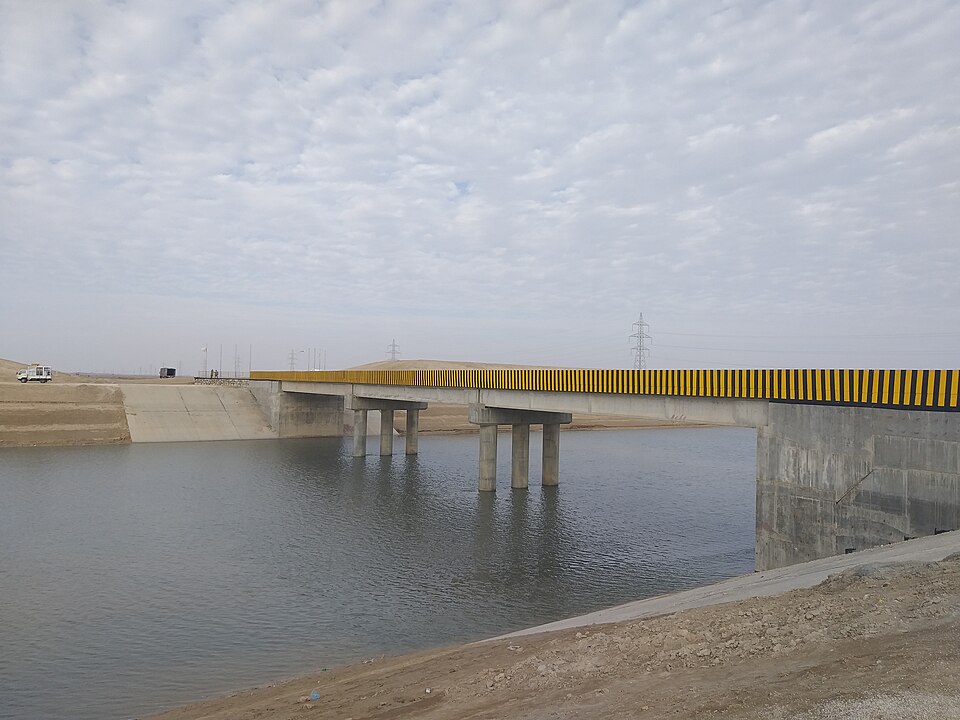





A research group from Japan and Afghanistan has conducted a techno-environmental and economic assessment of a canal-top PV (CTPV) system on Afghanistan’s Qush-Tepa irrigation canal. To this end, the researchers introduced a framework termed the integrated techno-economic-environmental assessment (ITEEA), which they say is transferable to other developing regions with similar characteristics, including India, Pakistan, North and East Africa, and parts of Southeast Asia.
“The ITEEA framework explicitly quantifies energy production, water-evaporation reduction, land-use savings, and economic performance within a single analytical structure,” corresponding author Hameedullah Zaheb told pv magazine. “This integrated perspective is particularly important for fragile and resource-constrained regions, where infrastructure must serve multiple objectives simultaneously. We are interested in extending the ITEEA framework to other transboundary canal systems in Central and South Asia.”
Discussing the results of the framework’s application to the Qush-Tepa canal, Zaheb said one of the most striking findings was the scale of water savings achievable through canal shading. “Even with partial canal coverage, evaporation reductions translate into hundreds of millions of cubic meters of conserved water over the project lifetime, which has economic and strategic significance comparable to electricity generation itself,” he added.
Work on the Qush-Tepa irrigation canal began in 2022 and is expected to be completed in 2028. Located in northern Afghanistan, the project diverts water from the Amu Darya River to irrigate around 550,000 hectares and serve more than 60,000 households. The canal is planned to have a length of 285 km, excluding sub-canals, with a top width of 125 m, a bed width of 85 m, a water depth of 6.5 m, and a total canal depth of 8 m.
The group’s ITEEA framework begins with geospatial screening and a pre-feasibility assessment, using remote-sensing datasets, GIS layers, and stakeholder interviews. In the second step, techno-economic and environmental modeling is conducted using the System Advisor Model (SAM) for energy simulation and the evaporation coefficient method (ECM) for hydrological assessment. The third step focuses on engineering design and system optimization, including modular system configuration, canal spatial layout, and surface coverage.
In the fourth step, the system is installed and enters operation. At this stage, the framework accounts for bifurcated outputs, such as water flows via pumps to agricultural storage or farms, and electricity generation for rural electrification or grid export. The fifth step addresses policy integration, grid compliance, and stakeholder engagement. In the final step, a closed-loop learning approach is used to compare real-time performance data with baseline projections.
Based on the first three steps, the researchers selected a section of the canal near Mazar-i-Sharif for the CTPV deployment, as it offers higher solar potential. They chose 550 W crystalline-silicon PV modules with 19% efficiency, installed at a tilt angle of 0° and an azimuth of 180°, facing south. The modeled system had a total capacity of 836 MW. As this was a simulation study, the team did not deploy the system but instead modeled its operation using capacity factors of 18%, 20%, and 23%.
“The CTPV system is designed with an installed capacity of 836 MW, and using a base-case capacity factor of 20%, the system is capable of generating approximately 1,465 GWh annually, with a sensitivity range of 1,318–1,684 GWh corresponding to capacity factors of 18–23%,” the group explained. “Furthermore, the system reduces water evaporation by approximately 20%, conserving about 445 million m3 of water and yielding water-saving benefits valued at approximately USD 200 million over 25 years.
“Land-use savings contribute an additional USD 118 million to the total benefits,” the scientists explained. “The initial investment required is approximately $1.08 billion, and project economics are evaluated over a 25-year lifetime at a base discount rate of 12%, with sensitivity analysis across 8–16%. Under favorable financing and performance scenarios, the system demonstrates positive economic returns, while results remain sensitive to capacity factor and discount rate assumptions.”
The research work was presented in “Canal-top photovoltaic systems on the Qush-Tepa Canal: a model for energy–water synergy,” published in Energy Conversion and Management: X. Researchers from Japan’s University of the Ryukyus, Afghanistan’s Kabul University, and Avicenna University have participated in the study.
This content is protected by copyright and may not be reused. If you want to cooperate with us and would like to reuse some of our content, please contact: editors@pv-magazine.com.

How fast are the waters flowing in this canal?