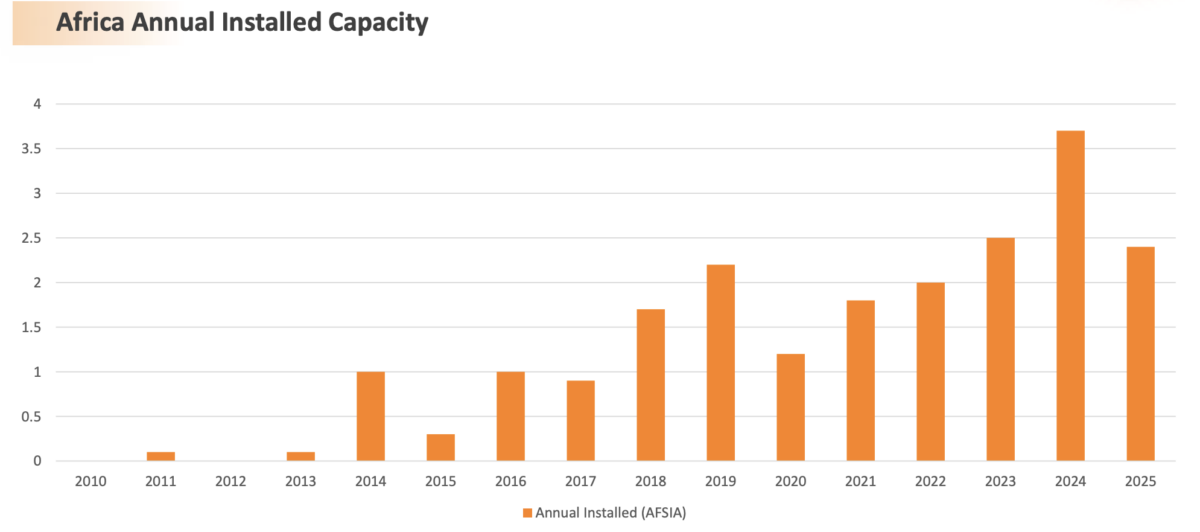





Africa installed at least 2.4 GW of solar in 2025, according to figures from the Africa Solar Industry Association’s (AFSIA) Africa Solar Outlook 2026 report.
The figure is similar to the 2.5 GW of solar that AFSIA recorded as deployed in 2024 at the time of its last annual report but the association has since registered a further 1.2 GW of projects that came online in 2024 in its project database, increasing 2024’s figure to 3.7 GW.
AFSIA’s project database has now identified a cumulative operational solar capacity of 23.4 GW across Africa. The database currently includes more than 42,000 projects, a 40% increase in the number of projects at the end of 2024. It covers projects at all stages of development with a combined capacity of 296 GW.
While Africa’s official cumulative solar capacity keeps growing, AFSIA’s latest report says solar may already be up to 2.75 times more prevalent across the continent than data collection has so far highlighted due to the number of solar module imports from China.
AFSIA’s report says Africa’s total installed capacity to date could be as high as 63.9 GW. The figure is based on official Chinese solar module export data that indicates 58.1 GW of modules have been imported into Africa since 2017, including 16.1 GW last year alone, with a further 10% extrapolated to account for exports prior to 2017.

The report adds that when taking into account Chinese export data, Africa was the world’s fastest growing region for solar in 2025, at a compound annual growth rate of 17%, compared to the global average of 2%.
In the report, AFSIA CEO, John van Zuylen, wrote that the latest data collected changes prior perceptions that Africa was one of the least attractive solar regions and highlights that the continent has a much bigger market share than once thought.
“Africa now appears to be experiencing one of the fastest growths on the globe and therefore becoming a key market to tap into for all types of industry stakeholders,” van Zuylen wrote. “The next few years will show if this growth is only temporary or is based on strong foundations that make solar the unavoidable way forward to electrify the African continent.”
The association expects that the currently-unidentified solar in Africa consists of C&I and residential installations, due to the official documentation of utility-scale projects, consistent reporting of SHS and PUE systems and minigrids most often being government-led programs.
The report estimates, based on conversations and interviews with C&I and residential installers across Africa, that 85% of the unidentified capacity is in the C&I market, with the remaining 15% in the residential sector.
This content is protected by copyright and may not be reused. If you want to cooperate with us and would like to reuse some of our content, please contact: editors@pv-magazine.com.



1 comment
By submitting this form you agree to pv magazine using your data for the purposes of publishing your comment.
Your personal data will only be disclosed or otherwise transmitted to third parties for the purposes of spam filtering or if this is necessary for technical maintenance of the website. Any other transfer to third parties will not take place unless this is justified on the basis of applicable data protection regulations or if pv magazine is legally obliged to do so.
You may revoke this consent at any time with effect for the future, in which case your personal data will be deleted immediately. Otherwise, your data will be deleted if pv magazine has processed your request or the purpose of data storage is fulfilled.
Further information on data privacy can be found in our Data Protection Policy.