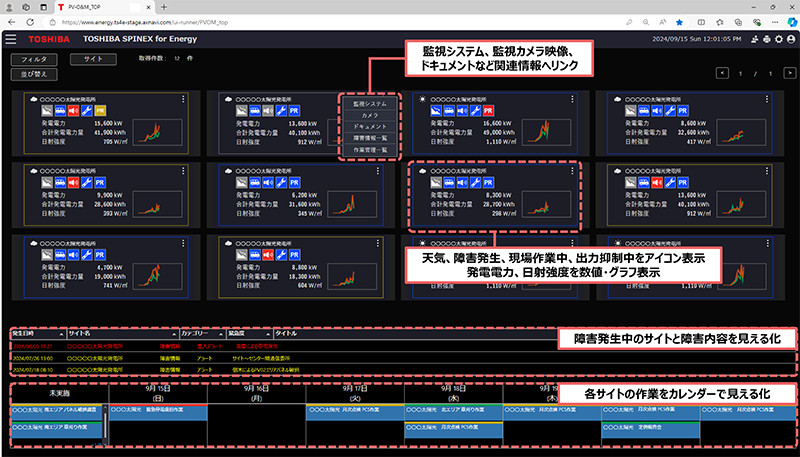





Japanese industrial conglomerate Toshiba has launched EneTogo, a new management plaform for operation & maintenance (O&M) of multiple solar power plants in real time.
EneTogo forms part of the company’s Toshiba Spinex for Energy portfolio, a digital services suite aimed at utilities and industrial companies. The PV management platform aggregates operational data across distributed solar assets, helping operators monitor performance, respond to faults, and manage inspections more efficiently, according to the company.
The system can automatically calculate plant capacity factor, by collecting generation data from each of its inverters. It can automatically detect equipment producing zero output despite available solar irradiation, while analyzing factors such as weather data, maintenance records, construction work, or output curtailment to determine the cause of downtime. AI models estimate lost generation during shutdown periods, enabling automated occupancy calculations based on power output rather than manual reporting.
The platform also introduces performance ratio (PR) monitoring at the individual power conversion system (PCS) level. PR values are commonly used to evaluate whether a solar plant is performing as expected relative to available solar energy. Using a proprietary prediction model that incorporates solar irradiance measurements, PV panel capacity, and installation angles, EneTogo estimates expected hourly generation for each PCS. Operators can compare actual performance to the predicted baseline PR value, allowing early detection of underperforming equipment.
An embedded AI-driven troubleshooting tool enables PV plant operators to interact with a generative AI assistant via chat to diagnose eventual equipment faults. Drawing on the platform’s existing database of fault events, repair histories, and inspection records, the system suggests potential causes and solutions. Toshiba says the feature can help less experienced staff quickly identify corrective actions, accelerating fault resolution and reducing downtime.
The platform also includes a function that automatically generates operational reports and incident summaries. By integrating plant performance data with generative AI, the system can produce draft reports covering routine operations, equipment failures, and potential countermeasures.
Toshiba says its Spinex service is currently used across solar installations totaling 929 MW in Japan.
Looking ahead, the company plans to extend the platform beyond solar installations to support battery storage systems, solar-plus-storage facilities, and wind power plants. The company also expects demand to increase particularly among high-voltage and extra-high-voltage solar installations with capacities of 50 kW or larger, where efficient maintenance and operational coordination are critical for maximizing energy yield.
This content is protected by copyright and may not be reused. If you want to cooperate with us and would like to reuse some of our content, please contact: editors@pv-magazine.com.



By submitting this form you agree to pv magazine using your data for the purposes of publishing your comment.
Your personal data will only be disclosed or otherwise transmitted to third parties for the purposes of spam filtering or if this is necessary for technical maintenance of the website. Any other transfer to third parties will not take place unless this is justified on the basis of applicable data protection regulations or if pv magazine is legally obliged to do so.
You may revoke this consent at any time with effect for the future, in which case your personal data will be deleted immediately. Otherwise, your data will be deleted if pv magazine has processed your request or the purpose of data storage is fulfilled.
Further information on data privacy can be found in our Data Protection Policy.