





Singapore added 504 MW of solar last year, according to a report published by the country’s Energy Market Authority (EMA).
Figures from the authority’s Singapore Solar Photovoltaic Report Q4 2025 state that cumulative solar capacity reached 2,093 MW by the end of last year, up from 1,589 MW at the end of 2024.
The result continues an upward trajectory in yearly capacity growth, compared to annual additions of 397 MW in 2024 and 370 MW in 2023.
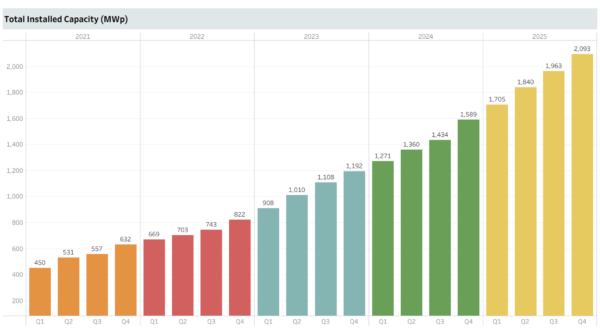
Image: Energy Market Authority of Singapore
The number of solar installations in Singapore increased by 3,400 last year, EMA’s figures add, from 11,225 at the end of 2024 to 14,625 by the end of 2025.
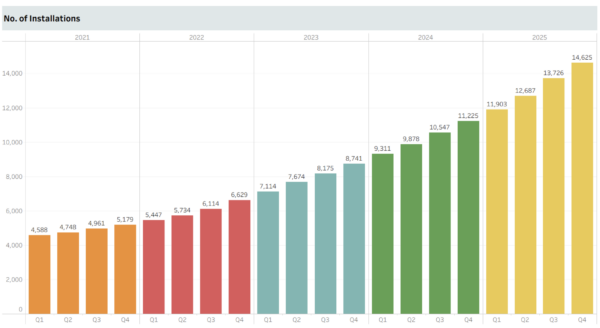
Image: Energy Market Authority of Singapore
Singapore’s solar market is dominated by rooftop solar, which makes up more than 80% of total capacity. Lam Pham and Alnie Demoral, energy analysts at Ember specializing in Asian markets, told pv magazine a key market driver continues to be solar’s increasing cost-competitiveness, with payback period falling to as short as five years and consumers also able to sell excess solar to the grid.
They added that the market is supported by government-led programs, such as SolarNova from the Housing and Development board, which had installed solar on 5,300 blocks as of December last year.
Other government support programs include SolarRoof and SolarLand from JTC, a government agency for industrial development under the country’s Ministry of Trade and Industry. Supported projects include Singapore’s largest ground-mounted solar project to date, the 118 MW Sembcorp Jurong Island Solar Farm, which was completed last year. The installation, spanning 60 hectares across six plots of interim vacant land, was built by Singaporean state-owned energy and urban development company Sembcorp.
Pham and Demoral said the main market driver in 2026 will be electricity prices due to Singapore’s large reliance on gas power plants.
“The current fuel shock will intensify gas price volatility. Fuel price is already up and electricity will likely be affected soon,” the pair said. “Coupled with the continuous decline of solar costs and batterys, this will drive the residential consumers to install solar panels.”
As a result of surpassing 2 GW of cumulative solar capacity last year, Singapore surpassed its original 2030 target and subsequently increased the goal to 3 GW by the end of the decade. Pham and Demoral said that while the 3 GW target will be a key market driver, it remains unclear if this year’s deployment level with surpass that seen last year.
“Demand will be growing certainly and costs will become more affordable, but the issue with Singapore is limited land availability,” they explained. “As projects with suitable land have been largely developed, those remaining will be more complex, take more time and constraint the pace of deployment.”
They pair also told pv magazine that Singapore could focus more on interconnection with neighbouring nations, such as Cambodia, Indonesia, Malaysia and Vietnam, to import solar electricity from other nations. “This will help unleash the land constraint and access large-scale solar resources abroad,” they said.
Last October, Singapore conditionally approved a 1 GW hydropower import project from Malaysia and last June, partnered with Indonesian on a solar supply chain initiative to be located in the Riau Islands as part of broader plans to enable cross-border clean energy trading.
Pham and Demoral also suggested regulators in Singapore could introduce more robust incentives for cross-border renewable energy procurement, such as counting imported solar electricity to renewables targets or carbon reduction commitments, and enhancing market structures to support flexibility with policies that promote energy storage, demand response and grid modernization.
EMA’s latest figures add that Singapore had 213.4 MW of operational energy storage systems by the end of last year.
UK consultants GlobalData are expecting Singapore to add between 300 MW and 400 MW of solar annually through to 2035, taking cumulative capacity past the 5 GW threshold.
This content is protected by copyright and may not be reused. If you want to cooperate with us and would like to reuse some of our content, please contact: editors@pv-magazine.com.


By submitting this form you agree to pv magazine using your data for the purposes of publishing your comment.
Your personal data will only be disclosed or otherwise transmitted to third parties for the purposes of spam filtering or if this is necessary for technical maintenance of the website. Any other transfer to third parties will not take place unless this is justified on the basis of applicable data protection regulations or if pv magazine is legally obliged to do so.
You may revoke this consent at any time with effect for the future, in which case your personal data will be deleted immediately. Otherwise, your data will be deleted if pv magazine has processed your request or the purpose of data storage is fulfilled.
Further information on data privacy can be found in our Data Protection Policy.