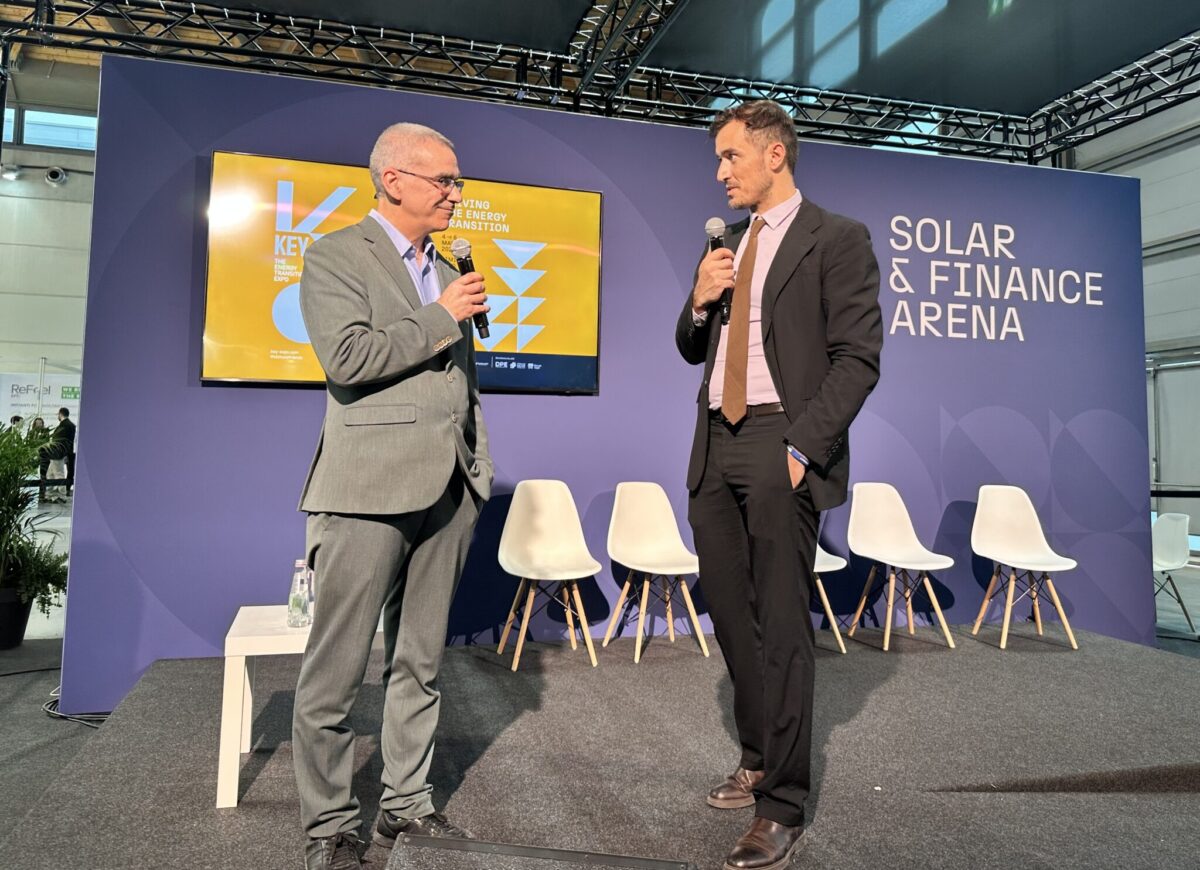





Key – the Energy Transition Expo held last week in Rimini, Italy, registered a 10% increase in total attendance and a 9% increase in foreign visitors, according to organizers.
“With 160 high-quality and rigorously scientific conferences, Key 2026 confirmed its status as one of Europe's most important energy events, standing out due to the completeness of its exhibition and content,” said the event's organizer, Italian Exhibition Group (IEG).
The organization said the conference hosted 530 buyers and delegations from 59 countries across 125,000 m² of exhibition space and 24 halls. The 2026 edition featured 1,065 exhibiting brands, approximately 30% of which were international. Geographically, the event focused on Italy, central Europe, the Mediterranean, and Africa.
“Italy wants to be a bridge between Africa and the Mediterranean, which is why we host delegations from Morocco, Tunisia, South Africa, and other African countries,” said Alessandra Astolfi, global exhibition director of the green and technology department at IEG.
The event included seven integrated sectors of the energy system: solar, energy storage, wind power, energy efficiency, hydrogen, electric mobility, and sustainable cities. Agrivoltaic solutions and business models drew strong interest.
In the face of unexpected regulatory changes, the event highlighted the resilience of Italy's photovoltaic sector and the growing role of consultancy firms and service providers. Experts discussed the Decreto Bollette, aimed at lowering electricity bills for consumers while reimbursing gas-fired power producers for gas transmission tariffs and EU Emissions Trading System (EU ETS) costs, to the detriment of the renewable energy and storage sectors.
In a quick chat with pv magazine, Italy's Energy Minister Gilberto Pichetto Fratin said coal is a strategic resource for Italy, and gas will continue to “accompany us for 30 to 40 years, because it guarantees the continuity of the system.” Pichetto Fratin also said solar plants do not need subsidies in Italy, arguing that power purchase agreements (PPA) will be essential to limit energy prices in the next decade. He added that current geopolitical tensions could encourage the European Commission to increase collaboration, especially for gas storage and supporting a European supply chain for modules and batteries.
The fair’s strong turnout reflects the rapid growth of Italy’s solar industry across all segments, despite new regulatory challenges.
A notable trend is emerging in the commercial and industrial (C&I) sector, where large rooftop PV projects increasingly pair with storage systems. Batteries are becoming key assets for small and medium-sized businesses seeking to reduce energy costs.
Agrivoltaics remains one of the most dynamic segments. The sector is expanding through dedicated tenders and the Fer X support scheme.
At a conference moderated by pv magazine, developers, operators, and producers of trackers and mounting systems said they expect standardization of agrivoltaic solutions and products over the next four to five years. Data from agrivoltaic projects will help operators understand how to select products, leading to more standardized mounting systems and technical guidelines by 2030-32.
In the meantime, technological development progresses through pilot projects, experimentation, and closer integration between engineering and agronomic expertise.
A recurring message was that agrivoltaic design must start with the needs of crops. Unlike conventional solar parks, agrivoltaic systems cannot be designed solely around energy production.
Valerio Natalizia, CEO of ECO The Photovoltaic Group, explained that his company manages projects across the entire value chain – from technical and electrical design to permitting – to reduce complications that often arise when multiple actors handle separate stages. Designing the project from the beginning avoids many potential issues during construction.
The company’s model also involves joint ventures with farmers and agronomists. Agrivoltaic systems are developed around specific crops such as kiwi and cherries, while a third partner may handle agricultural product distribution. The goal is to create an integrated economic model capable of benefiting from economies of scale as installed capacity increases.
The company plans to invest around €40 million ($46.2 million) over the next three to five years to develop several megawatts of agrivoltaic capacity.
Natalizia also cited a 120 kW pilot project in Castel Bolognese developed with a farm already experienced in protected cultivation. In this case, photovoltaic integration was treated as a natural extension of the agricultural system designed to protect crops. Even tracker settings – such as seasonal tilt adjustments – were defined based on agronomic priorities. The crop remained the guiding element of the entire design process.
While integrated design reduces problems early on, many challenges emerge during operation. Operations and maintenance (O&M) was a central topic, particularly ensuring agricultural and electrical activities do not interfere with each other.
Agrivoltaics requires balancing two operational cycles: farming and power plant maintenance. Electrical maintenance must not damage crops, trees, or soil, while agricultural work must not compromise system integrity.
Safety is a major concern, especially when farm workers operate within the solar installation area. Giuseppe De Benedictis, country manager of Goldbeck Solar, described an approach that allows the system to be completely de-energized when farmers enter operational zones. In the future, such processes could be automated to further reduce electrical risks.
Automation, artificial intelligence, and robotics may also help monitor crop growth, manage cultivation, and support harvesting. Digitalization is a key tool for integrated energy and agricultural management.
Another conclusion was that there is no universal agrivoltaic solution. Technology choices depend on crop type, farm machinery, wind and hail exposure, terrain, available space, and even animal behavior.
Vertical systems, for example, can preserve up to 99% of land for agriculture, according to Sascha Krause-Tünker, CFO of Next2Sun. They can also produce more electricity during morning and evening hours, but suitability depends on crop type and location.
Similarly, trackers introduce additional complexity. Alejandro Cardona, director at Soltec, noted that movable systems – typically evaluated for energy optimization – can also serve agronomic functions. By adjusting module orientation, trackers control the amount of solar radiation reaching crops and can protect them from hail or heavy rain.
Because agrivoltaics is still a young sector, many issues emerge only during deployment. Examples include soil compaction during construction, interference with farm machinery, insufficient maneuvering space, animals interacting with structures, rodents damaging cables, and long-term effects of fertilizers or chemicals on electrical components.
Rodent damage to cables was solved by adopting bite-resistant cables. Small layout adjustments – such as slightly reducing space between rows – can also complicate daily agricultural operations.
This mirrors the early years of conventional photovoltaics, when many technical challenges were discovered and addressed gradually.
The discussion emphasized the importance of collaboration. O&M, durability, crop protection, module development, and agronomic integration cannot be solved by a single actor.
Progress requires pilot projects, systematic data collection, knowledge sharing, and stronger cooperation among developers, technology suppliers, agronomists, and industry associations.
Even for modules, there is still no dedicated “agrivoltaic module.” Future products may emerge with enhanced durability, protective functions, or different balances between light transmission and power output. For now, the sector advances mainly by adapting existing photovoltaic technologies.
Ultimately, agrivoltaics’ success depends on proving that agriculture can function productively within these systems. The sector’s future relies not only on structural design or energy performance, but on achieving a mature balance between energy generation, agronomy, safety, maintenance, and local adaptation.
This content is protected by copyright and may not be reused. If you want to cooperate with us and would like to reuse some of our content, please contact: editors@pv-magazine.com.

By submitting this form you agree to pv magazine using your data for the purposes of publishing your comment.
Your personal data will only be disclosed or otherwise transmitted to third parties for the purposes of spam filtering or if this is necessary for technical maintenance of the website. Any other transfer to third parties will not take place unless this is justified on the basis of applicable data protection regulations or if pv magazine is legally obliged to do so.
You may revoke this consent at any time with effect for the future, in which case your personal data will be deleted immediately. Otherwise, your data will be deleted if pv magazine has processed your request or the purpose of data storage is fulfilled.
Further information on data privacy can be found in our Data Protection Policy.