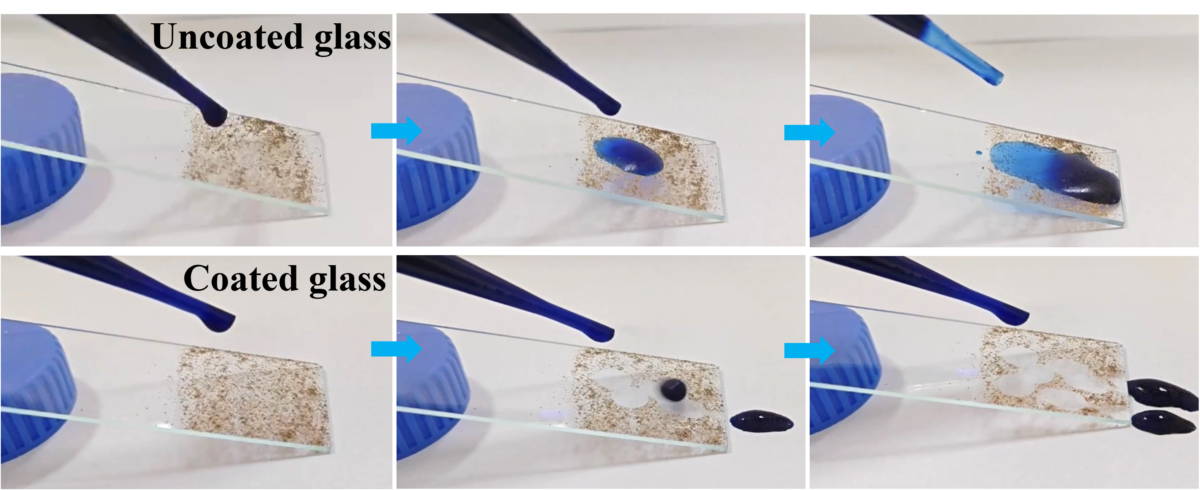





An international research team has developed a dual-layer sol-gel and hydrophobic silica coating that can significantly improve solar cell performance by protecting the surface from dust accumulation, light reflection, bird droppings, and water films.
“The dual-layer coating repels water, dust and dirt without reducing the amount of light reaching the photovoltaic cells,” the research's corresponding author, Shanhu Liu, told pv magazine. “Unlike many solutions on the market, it is made without forever chemicals, or per- and polyfluoroalkyl substances (PFAS).”
“Dust, dirt and bird droppings all affect solar panel performance. Maintenance risks damaging the panels, is costly and sometimes a logistical challenge,” said co-author, Sudhagar Pitchaimuthu. “Our clear, highly water-repellent coating works by combining a thin adhesive base layer with hydrophobic silica nanoparticles that lock into place as the material cures. The microscopic roughness created by these particles traps air at the surface, causing water to bead up and roll off, carrying dirt away with it. The result is a durable, transparent coating with strong self-cleaning performance.”
In the paper “Sol-gel preparation of transparent and superhydrophobic silica coatings for self-cleaning solar panels,” published in Colloids and Surfaces A: Physicochemical and Engineering Aspects, the scientists described the protective film as dual-layer transparent superhydrophobic coating combining sol-gel processed hydrophilic silica sol with hydrophobic silica nanoparticles.
The sol-gel process is a wet-chemical method used to produce thin films, coatings, or solid materials from a liquid precursor. In the process, liquid precursors react through hydrolysis and condensation to form a colloidal solution (sol). As the reactions progress, the particles link together to create a three-dimensional network, transforming the sol into a gel. The gel is then deposited on a surface and heat-treated to form a thin, solid coating such as an anti-reflective layer used in solar modules.
For the novel coating, the research group used glass slides as substrates and chemicals such as tetraethyl orthosilicate (TEOS), ethanol, ammonia solution, and hydrophobic silica nanoparticles. The glass substrates were first cleaned ultrasonically with detergent and ethanol, rinsed with deionized water, and dried to remove contaminants. A silica sol was then prepared using TEOS, ethanol, water, and ammonia as a catalyst to promote hydrolysis and condensation reactions.
After aging, the sol formed a transparent solution used to coat the glass through a dip-coating process, followed by drying to obtain a hydrophilic silica layer. To create a superhydrophobic surface, hydrophobic silica nanoparticles were dispersed in ethanol and deposited onto the coated glass by repeated dip-coating cycles. The number of coating cycles and nanoparticle concentrations were varied to optimize optical transmittance and surface wettability. The samples were then sintered at different temperatures to improve coating stability and performance.
The quality, composition and performance of the coating was analyzed through scanning electron microscopy (SEM) and atomic force microscopy (AFM), Fourier transform infrared (FTIR) spectroscopy, X-ray diffraction (XRD) analysis, X-ray photoelectron spectroscopy (XPS), and UV–Vis spectroscopy.
The analysis showed that coating exhibits excellent superhydrophobicity with a water contact angle of about 154° and a sliding angle of 1.5°. High optical transparency was also achieved, with transmittance reaching 96.2% due to the refractive-index gradient created by the silica layers. Mechanical tests also demonstrated strong durability against abrasion, sand impact, and water droplet impact, the scientists said, noting that the coating also showed good chemical stability in neutral and acidic environments and maintained performance during outdoor exposure.
Finally, when applied as cover glass for photovoltaic cells, the coating increased light transmission and improved solar cell efficiency from 13.90% to 14.56%.
“Improving the performance of solar cells and panels could have an incredible cumulative effect,” said co-author, Sanjay S. Latthe.
“Over the past 20 years, a range of coatings have been brought to market, but they all have limitations. Our next focus is testing the coating in panels in extreme weather conditions, from Scottish winters with low temperatures and rainfall to desert conditions in Dubai. We should have our product to market within five years, if not sooner.”
The research team included scientists from China's Research Institute of Petroleum Exploration and Development and Henan University, as well as India's Vivekanand College and Heriot-Watt University in the United Kingdom.
This content is protected by copyright and may not be reused. If you want to cooperate with us and would like to reuse some of our content, please contact: editors@pv-magazine.com.



By submitting this form you agree to pv magazine using your data for the purposes of publishing your comment.
Your personal data will only be disclosed or otherwise transmitted to third parties for the purposes of spam filtering or if this is necessary for technical maintenance of the website. Any other transfer to third parties will not take place unless this is justified on the basis of applicable data protection regulations or if pv magazine is legally obliged to do so.
You may revoke this consent at any time with effect for the future, in which case your personal data will be deleted immediately. Otherwise, your data will be deleted if pv magazine has processed your request or the purpose of data storage is fulfilled.
Further information on data privacy can be found in our Data Protection Policy.