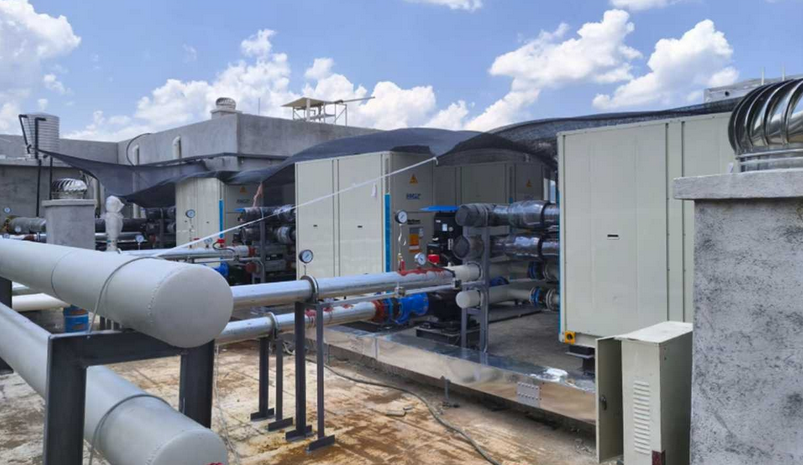





Researchers from China's Hunan Institute of Engineering, Chinese environmental engineering company Hunan Diya Environmental Engineering and electromechanical technology Hunan Zunfeng Electromechanical Technology
The new system was implemented in a hotel in Huaihua City, Hunan Province, providing a real-world demonstration of its winter operation. “The proposed system designs are for building retrofits only,” the study’s lead author, Xianglong Liu, told pv magazine.
The research evaluated four heating configurations to assess efficiency and performance under winter conditions. The first paired an energy tower heat pump with a boiler at the condenser side, providing supplemental heat directly to the condenser output. The second placed the boiler at the evaporator side, ensuring additional heating at the evaporator inlet. The third combined an air-source heat pump with conventional boilers, integrating two complementary heat sources. The fourth supplemented the energy tower heat pump with photovoltaic-thermal (PVT) energy, using solar water heating to reduce reliance on fossil fuels.
To optimize winter performance, four operational modes were developed. In the condenser-side boiler mode, the boiler raises the condenser outlet temperature to 45 C to meet heating demand. The evaporator-side boiler mode adds heat directly at the evaporator inlet, maintaining the refrigerant at the proper temperature. The air-source heat pump configuration uses a reduced-capacity boiler for flexible supplemental heating. Finally, the solar-assisted energy tower heat pump mode incorporates solar water heating, reducing dependence on natural gas or electricity while enhancing overall efficiency.
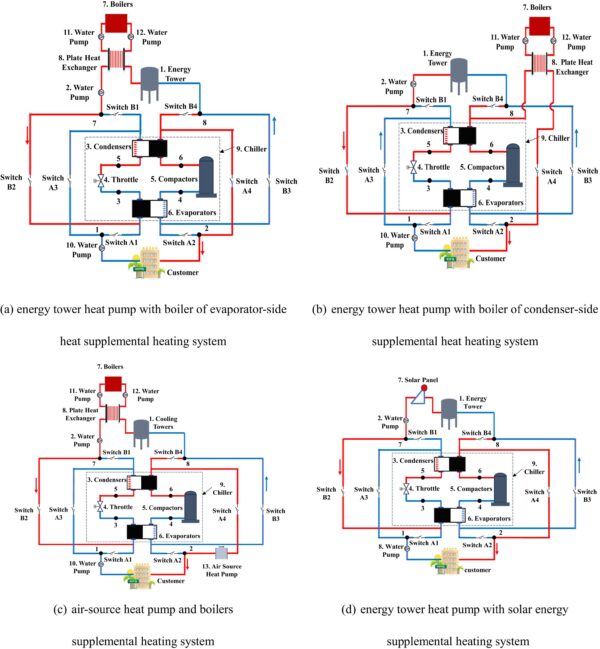
Image:
Hunan Institute of Engineering, Energy Reports, CC BY 4.0
In all system configurations, Chillers operate year-round, with switches managing cooling and heating modes. During winter, the energy tower heat pump provides primary heating, supplemented by boilers, air-source heat pumps, or solar water heaters as needed to maintain evaporator outlet temperatures between 1–6 C and condenser outlets at 35–45 C.
Through thermodynamic analysis, the scientists found that the energy tower heat pump with an evaporator-side boiler and the solar-assisted system achieved the highest average coefficients of performance (COPs) of 1.904 and 1.891, respectively, compared to 1.595 for the condenser-side boiler system. Exergy efficiency followed a similar trend, withe the solar-assisted system and evaporator-side boiler system reaching 11%, while the condenser-side boiler system achieved only 4.4%.
Techno-economic analysis demonstrated significant energy savings. The energy tower heat pump with an evaporator-side boiler saved CNY 185,100 ($26,902) in natural gas compared with a conventional tower heat pump, while the air-source heat pump with boilers saved CNY 184,800, and the solar-assisted energy tower heat pump saved CNY 187,300. Electricity use increased slightly due to pump operation, but the natural gas savings far outweighed these costs.
Moreover, the PVT-assisted system was found to offer substantial long-term savings but requires careful planning due to high installation costs, potential space limitations, and variable solar output.
“Our study demonstrates that energy tower heat pumps combined with solar or supplemental boilers offer a sustainable, economically viable solution for winter heating in commercial buildings,” Liu said. “By leveraging system-level coordination, energy managers can significantly reduce fossil fuel use while maintaining indoor comfort—an important step toward net-zero building operations.”
The tower heat pump system was described in “A new system of energy tower heat pump combined with boilers and solar energy,” published in Energy Reports.
This content is protected by copyright and may not be reused. If you want to cooperate with us and would like to reuse some of our content, please contact: editors@pv-magazine.com.


By submitting this form you agree to pv magazine using your data for the purposes of publishing your comment.
Your personal data will only be disclosed or otherwise transmitted to third parties for the purposes of spam filtering or if this is necessary for technical maintenance of the website. Any other transfer to third parties will not take place unless this is justified on the basis of applicable data protection regulations or if pv magazine is legally obliged to do so.
You may revoke this consent at any time with effect for the future, in which case your personal data will be deleted immediately. Otherwise, your data will be deleted if pv magazine has processed your request or the purpose of data storage is fulfilled.
Further information on data privacy can be found in our Data Protection Policy.