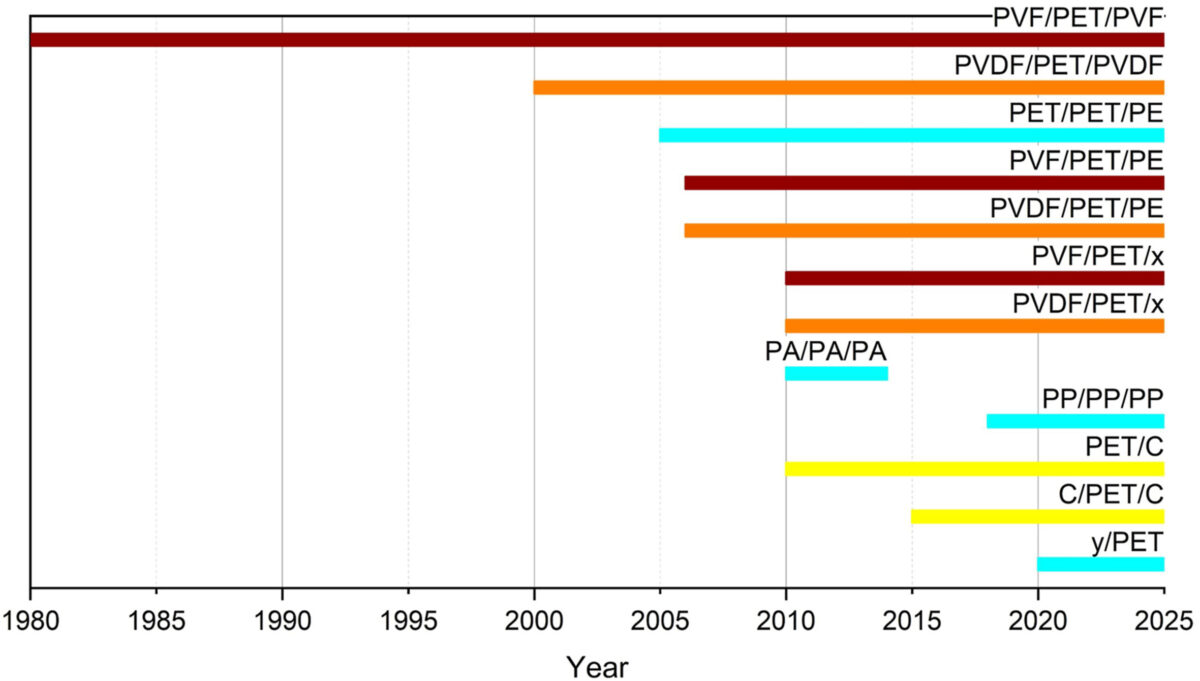





Researchers from the Austrian Research Institute for Chemistry and Technology have evaluated how fluorine (F) content evolved in PV module backsheets over the past three decades and have found that both the relative and absolute fluoropolymer content in recently installed PV systems decreased significantly.
F-containing polymers are often associated with environmental and health concerns because they can belong to the PFAS family, which is highly persistent in the environment and may accumulate in living organisms, raising long-term toxicity and pollution risks.
“Many PV backsheet types are known to contain fluoropolymers. However, quantitative data on their fluorine content is limited,” corresponding author Anika Gassner told pv magazine. “Using a combination of layer-resolved material identification, thickness measurements, and elemental analysis, we determined the F-content of complete backsheet structures.”
The scientists explained that earlier backsheet designs mainly used three-layer polyvinyl fluoride (PVF) / polyethylene terephthalate (PET) / polyvinyl fluoride (PVF) structures, later supplemented by polyvinylidene fluoride (PVDF)-based and other fluoropolymer variants. From around 2010 onwards, however, fluorine-free alternatives such as PET / polyethylene (PE) and coated PET systems became increasingly common due to cost and environmental advantages, driving a market shift from durable but fluorine-rich multilayer systems toward simpler coated or fluorine-free designs.
To determine the F content of backsheet materials, the research team conducted qualitative and quantitative analysis, including layer-specific composition, layer thickness and density, and the fluorine content of each layer. Small 1 cm × 1 cm samples were cut from PV backsheets, embedded in epoxy resin, and polished to obtain flat cross-sections for analysis.
Optical microscopy was used to measure layer thicknesses, while attenuated total reflection–infrared (ATR-IR) imaging with Fourier-transform infrared (FTIR) spectroscopy was used to identify the polymer composition of each layer. Moreover, scanning electron microscopy (SEM) was combined with energy-dispersive X-ray spectroscopy (EDX) to estimate surface elemental composition.
“We analyzed 23 representative backsheet samples from modules manufactured between 1988 and 2024,” Gassner said. “This allowed us to compare the F content of older and newer designs and of different materials.”
The analysis showed that strongly varying fluorine contents in individual layers, with PVF reaching around 30 wt%, PVDF around 42 wt%, and tetrafluoroethylene-hexafluoropropylene-vinylidene fluoride (THV) reaching up to 71.5 wt%. Outer coatings ranged from fluorine-free to low fluorine contents, reflecting high variability across backsheet designs.
Furthermore, the academics found that total fluorine content of full backsheets ranged widely from 0 wt% to about 17 wt%, decreasing in newer designs due to thinner fluoropolymer layers, thicker PET cores, and increasing use of fluorine-free layers or coatings, down to 0.04–0.8 wt%.
When combined with estimated market shares, the results indicate a general decline in fluoropolymer use in recent years, although legacy PV systems with higher fluorine content will continue to dominate end-of-life waste streams in the coming decades.
“We found that older backsheets containing PVF outer and inner layers can have F-content of up to 12 wt%,” Gassner stressed. “This value decreased to 2.8–4.7 wt% when the inner layer was substituted with PE or a coating in many backsheet designs between 2010 and 2020.”
“Additionally, we linked the measured results to the estimated market share of backsheet designs reported by industry surveys,” she went on to say. “This can help estimate the influence of backsheets on end-of-life and, in particular, recycling practices of PV modules. Although backsheets account for only 2-3% of PV modules, strict regulatory limits are in place due to the generation of HF during the thermal treatment of fluoropolymers, making it an important concern for recyclers.”
The research work was presented in “Evolution of the fluorine content in photovoltaic module backsheets,” published in Solar Energy Materials and Solar Cells.
This content is protected by copyright and may not be reused. If you want to cooperate with us and would like to reuse some of our content, please contact: editors@pv-magazine.com.


By submitting this form you agree to pv magazine using your data for the purposes of publishing your comment.
Your personal data will only be disclosed or otherwise transmitted to third parties for the purposes of spam filtering or if this is necessary for technical maintenance of the website. Any other transfer to third parties will not take place unless this is justified on the basis of applicable data protection regulations or if pv magazine is legally obliged to do so.
You may revoke this consent at any time with effect for the future, in which case your personal data will be deleted immediately. Otherwise, your data will be deleted if pv magazine has processed your request or the purpose of data storage is fulfilled.
Further information on data privacy can be found in our Data Protection Policy.