Emiliano Bellini

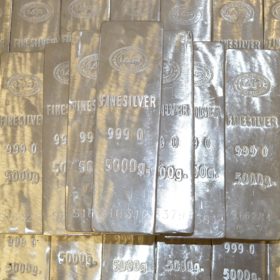
Silver price surge shows no signs of slowing, hitting a new all-time high of $117.66 per ounce
Silver hit a new all-time high of $117.66/oz, climbing over 40% in the past month and 275% in the past year, driven by dollar weakness, geopolitical tensions, and gold’s strong momentum. Silver analyst Matthew Piggott tells pv magazine the metal may reach $130/oz within a couple of weeks.

Korean scientists build mini perovskite solar module with 22.56% efficiency
GIST researchers have developed a perovskite mini-module with 22.56% efficiency by improving the SnO₂ electron transport layer with PEI, reducing defects and electron loss. The module retained 94% of its performance after 500 hours, highlighting potential for scalable, stable perovskite solar cells and modules.
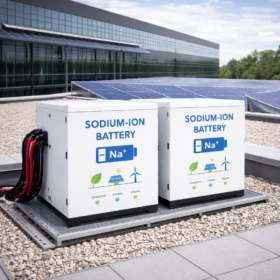
Sodium-ion batteries now competitive in niche markets
Sodium‑ion batteries are emerging as a safer, lower-cost alternative to lithium‑ion, with a recent international study highlighting their competitiveness in stationary energy storage. The research shows that ongoing investment and supply-chain development could enable broader adoption within the next decade.
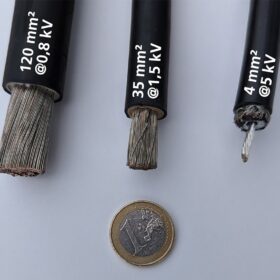
Fraunhofer ISE developing world’s first medium-voltage solar plants
Germany’s Fraunhofer Institute for Solar Energy Systems (Fraunhofer ISE) is developing the world’s first medium-voltage PV plants in Germany to cut material use, reduce costs, and simplify grid integration. They will test 1,500 V and 3 kV string configurations to create cost-effective, voltage-resistant components for large-scale solar.
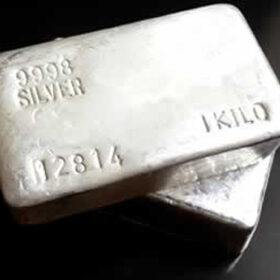
Analysts warn of possible, sudden silver price fall
pv magazine has spoken with silver analysts from Bloomberg and StoneX about the vertiginous growth of silver prices in recent weeks. They both agree that when prices rise too fast, investors’ behavior may change quickly. Meanwhile, the price of the precious metal has reached another all-time high today at $110 per ounce.
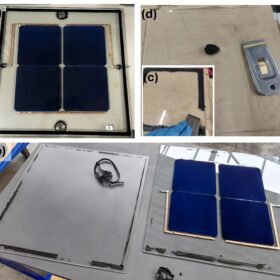
TU Delft unveils liquid solar module encapsulation tech
TU Delft researchers have developed a liquid-based solar module encapsulation that performs on par with conventional EVA panels while offering improved recyclability and circularity. The approach is compatible with silicon and tandem perovskite/silicon cells and could support thermal management and integration into photovoltaic-thermal modules.

China PV module prices expected to hit $0.12/W in H2
China’s PV module prices are expected to hover around $0.12/W in the second half of 2026 as the removal of export VAT rebates, front-loaded demand, and persistent oversupply keep market sentiment volatile.

Silver price hits all time high of $108.17 an ounce
A more than 15% increase in silver prices over the past week is adding cost pressure to the solar supply chain, as silver paste costs currently represent around 30% of total PV module costs.

Scientists design low-cost sodium-ion battery with cheap electrode materials
Conceived for stationary energy storage, the proposed sodium-ion battery configuration relies on an P2-type cathode material and an hard carbon anode material that reportedly ensure full-cell performance. Electrochemical testing revealed initial capacities of 200 mAh/g for the cathode and 360 mAh/g for the anode with capacity retentions of 42% and 67.4% after 100 cycles.
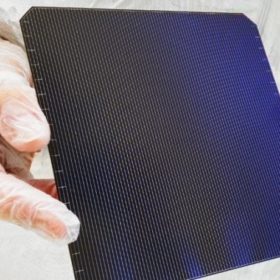
French scientists discover new UV-induced degradation pathways in heterojunction solar cells
Scientists from French research institute CEA-Liten have identified hydrogen migration in doped selective layers as the primary driver of UV-induced degradation in silicon heterojunction solar cells. They have also found that combined light and thermal light-soaking treatments can partially restore performance and improve long-term UV stability.
