Pilar Sánchez Molina
Spanish researchers develop ultra-thin solar cells for any surface
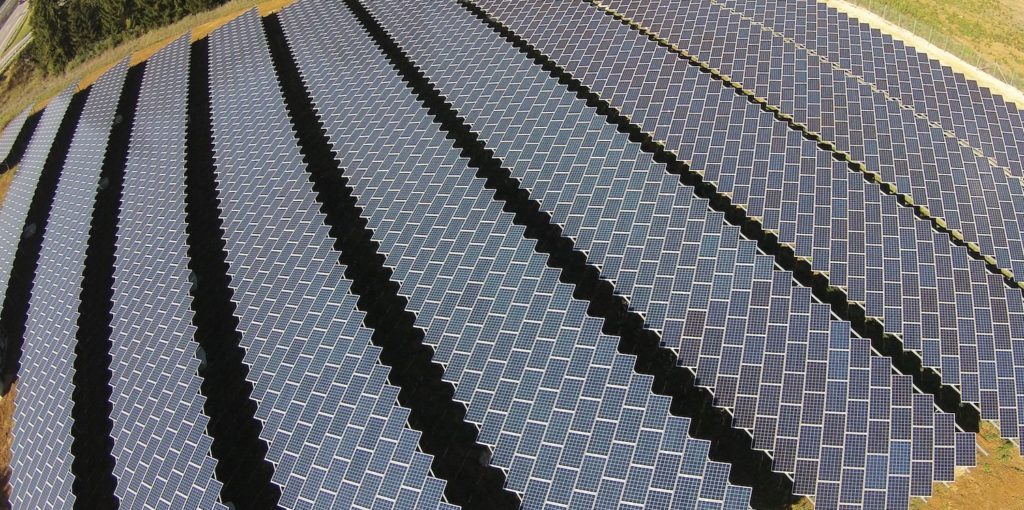
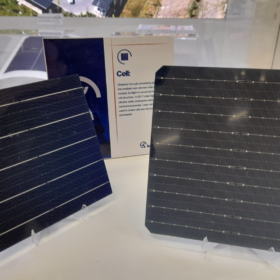
The Silicon and New Concepts for Solar Cells (SyNC) research group at the Institute of Solar Energy (IES) of the Polytechnic University of Madrid (UPM) has produced high-efficiency two-dimensional solar cell prototypes using the “hot-pick-up” technique, with simulations suggesting the cells could meet up to 30% of a building’s energy needs when applied to facades.

Dutch startup plans roll-to-roll factory for perovskite solar cells
TNO has launched Perovion Technologies to industrialize lightweight, flexible perovskite solar cells, targeting niche applications where conventional panels are unsuitable. The company plans to build the first roll-to-roll perovskite solar cell manufacturing facility in the Netherlands by 2030.

Arctech presents dry cleaning robot weighing just 38 kg
The Chinese manufacturer said its new Star Shine I system is already available in Europe and can operate at speeds of 10–18 m/min, performing cleaning routes of up to 3 km round trip and 9 km in a single direction.
Ciemat unveils large-area multispectral solar simulator for PV module testing
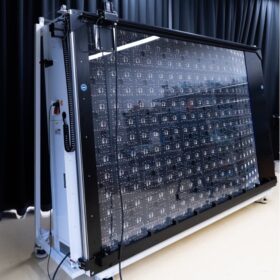
The system enables measurements under controlled irradiance, spectrum, and temperature conditions. It can combine 0.4% spatial irradiance uniformity, 500 ms illumination pulses, and dynamic I-V acquisition to accurately test high-capacitance photovoltaic modules in a single pulse, according to Ciemat.
Global solar capacity to reach 6 TW by 2031, says GlobalData
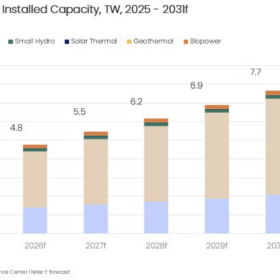
GlobalData says global renewable capacity will more than double to 8.4 TW by 2031, with PV reaching nearly 6 TW, a 13% compound annual growth rate from 2025 levels of 4.1 TW.
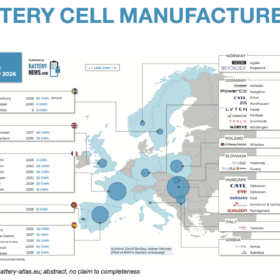
‘Battery Atlas 2026’ maps Europe’s cell, pack and battery manufacturers
The “Battery Atlas 2026” report shows consolidation in Europe’s battery market. More than 2,000 GWh of cell production capacity was announced in 2023, but the realistic forecast for early 2026 is around 1,190 GWh, including approximately 673 GWh led by Asian companies.
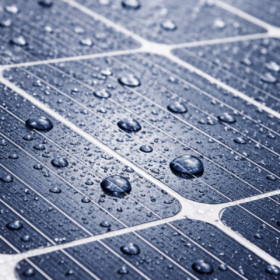
Hybrid perovskite solar cell generates power from sun and rain
Researchers at ICMS in Seville have developed a hybrid perovskite solar cell that generates electricity from both sunlight and raindrops, using the photovoltaic and triboelectric effects. A fluorinated CFₓ polymer layer enables water resistance, triboelectric energy harvesting, and high light transparency without reducing solar cell efficiency.
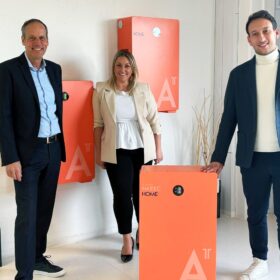
Austria’s Accupower launches residential sodium-ion battery
The Natec Home has a nominal capacity of 7.68 kWh and a power output of 3.8 kW, and allows parallel connection of up to 15 units. The reference price is set at €3,990.
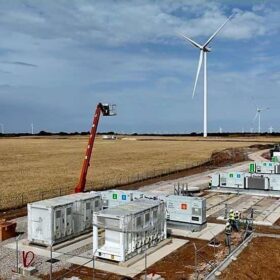
High PV curtailment expected in Spain through 2027
Aurora Energy Research says uncompensated PV curtailment will remain elevated in 2026 and 2027, reaching 3.05 TWh next year and 3.38 TWh in 2027, as grid constraints persist despite planned reinforcements.
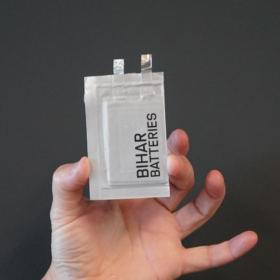
All European sodium-ion battery manufacturers at a glance
The European Economic and Social Committee (EESC) will place sodium batteries at the center of its work on the EU’s industrial strategy and is calling for swift action. pv magazine has compiled a list of manufacturers developing this technology in Europe.
