Sandra Enkhardt

German batteries stabilizing solar energy prices at expense of own profitability
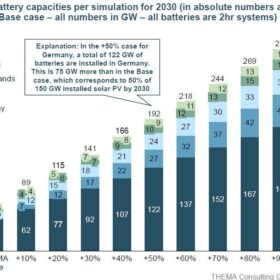
Analyst Thema Consulting Group has calculated the impact of rapid expansion of battery storage systems in Germany and found they will help stabilize solar prices by reducing the number of negatively-priced-electricity hours – but will cannibalize their own revenue in doing so.

Germany’s day-ahead market posts 389 hours of negative prices in H1
Germany recorded 141 hours of negative day-ahead electricity prices in June, just below the record set in May, bringing the first-half total close to the full-year figure for 2023.

Germany to introduce new product standard for plug-in solar devices
The standard is intended to regulate basic safety requirements and testing. However, an international standard is currently being developed that reaches partially contradictory results. The German Commission for Electrical, Electronic & Information Technologies, however, is taking a relaxed view of this.

Jinko Solar expects transition phase for PV market to last until 2027-28
JinkoSolar expects the PV market transition to last until 2027-28 due to negative power prices and project delays in Europe. In an exclusive interview with pv magazine, Vice President Europe Frank Niendorf says growth will recover as storage and hybrid systems expand and consolidation progresses.

Ikea begins offering balcony solar kits
Swedish furniture retailer Ikea is selling plug-in solar kits in Germany, with storage-inclusive systems starting at €1,229 ($1,425) and reaching €2,800 for versions featuring four 520 W panels. The kits are designed for residential self-consumption and vary by capacity and configuration.

Segen, BNP Paribas offer C&I energy storage, solar finance product
The new partnership will initially provide financing to help crowd in investment for photovoltaic systems and energy storage in Germany and the United Kingdom.

Germany deploys 1.1 GW of PV in May
Germany installed 1.1 GW of new solar in May, bringing total installations for the first five months of 2025 to 5.97 GW, slightly below the 6.16 GW added over the same period in 2024.

Swiss developer breaks ground on 1.6 GWh redox flow storage project
The redox flow project has enormous storage capacity, expected to be finished in mid-2028.
Stadium in Austria now hosting Europe’s largest PVT system
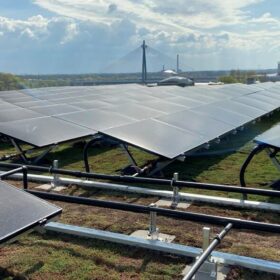
Austria has installed Europe’s largest photovoltaic-thermal (PVT) solar system at a stadium, using Sunmaxx modules combined with geothermal energy and brine heat pumps to provide climate-neutral electricity and heat.

Germany registers 130 hours of negative day-ahead power prices in May
Germany registered 130 hours of negative day-ahead power prices in May, driven by midday solar oversupply, as PV output regularly outpaced demand. The Fraunhofer Institute for Solar Energy Systems (Fraunhofer ISE) says prices dipped below €1/($1.14)MWh for 160 hours.
